

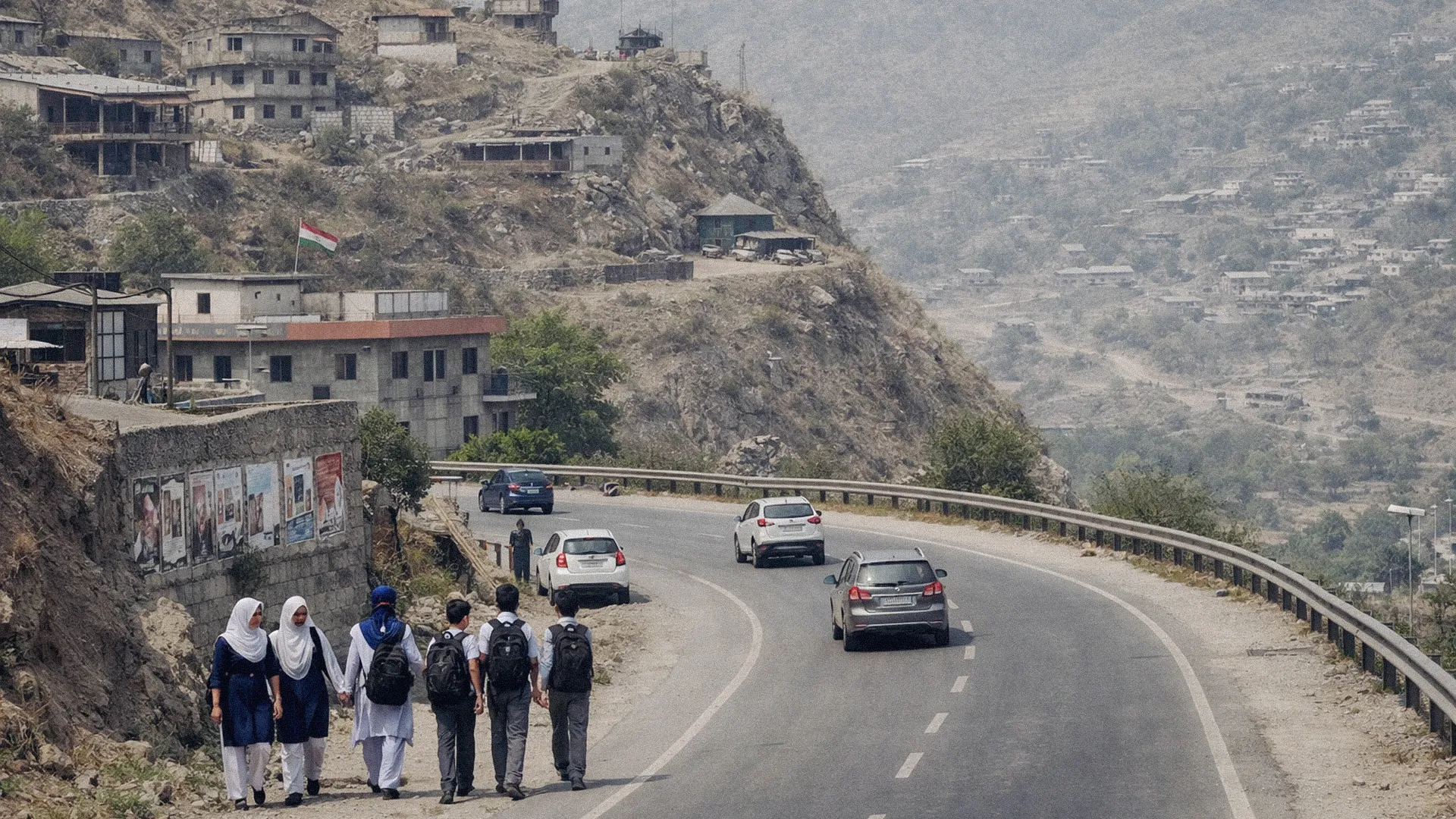
Go to any corner of Jammu & Kashmir these days, and you will find people talking about roads, schools, hospitals, industries, and employment opportunities, among others. Conflict, violence, terrorism, and security concerns have become secondary as the region rides on the wave of socio-economic development. The credit goes to New Delhi for sustained investments and policy initiatives as well as to the people of Jammu & Kashmir for their aspirations and enterprise.
For an ordinary Kashmiri person, the development taking place on the ground is real and not just an abstract promise made by political leaders. People, especially those living in rural and remote areas, have facilities of all-weather roads, allowing them smooth access to schools, hospitals, and markets. Establishment of premier institutes such as AIIMS, IIT, and IIM have expanded aspirations of the youth, entrepreneurs, and thousands of small businesses. The cumulative effect is quite visible on the ground, as the people’s talks are generally centred on livelihoods, mobility, aspirations, and opportunity rather than survival alone.
Ask anyone if this could have been possible a decade ago? The answer would definitely be a big no. But the region has chosen development over discord. This shift however did not happen overnight though the abrogation of Article 370 played a defining role in this amazing transformation that has changed the lives of people in Jammu & Kashmir. The government of India ensured sustained public investment, improved and strengthened people-centric governance and created infrastructure that catalysed growth. Equally important, the people of the region embraced and supported these efforts, moving beyond the decades of conflict, uncertainty and instability to build a better future.
The seeds of this transformation were sown way back in 2015, when the government sanctioned an INR 800 million package to the state of Jammu & Kashmir, causing a massive infrastructure push. Several highways were built and upgraded, which saw construction of tunnels and in difficult terrain, which were regarded as engineering marvels. Moreover, a strong network of rural roads was developed, which not only reduced travel time but created employment generation opportunities for people in remote areas by linking markets.

Interested in this ad?
Would you like to continue to the link or provide your information for more details?
Please provide your information
To continue, please fill in your details
Political opinions in Jammu & Kashmir continue to differ even today, but no one has the slightest doubt about the unprecedented public investment and improved governance that have taken place in the past one decade. Infrastructure development has become the most visible symbol of the change in Kashmir region, as the construction of a strong network of transport has bridged the gap between the mountainous terrain of Kashmir and the rest of India. The Chenab rail bridge, the world’s highest railway arch bridge, and the 324-km long Jammu-Baramulla rail line have played a transformative role by fundamentally altering the social and economic geography of Jammu & Kashmir.
Reliable power supply in the once energy-deficient region has brought big changes in the lives of people, and boosting local tourism and industrial activities. Moreover, over 16,799 households got rooftop solar facilities, thus ensuring seamless power and reduced expenditure on electricity. Those who cannot afford electricity are provided with free 200 units everyday, while farmers have received solar-powered irrigation pumps under government schemes. Jammu and Kashmir has received higher electricity support from the government of India if the tariff subsidy and related fund allocation to different states in the country are compared.
Facts and data strongly support the improvement in economic and human development in Jammu & Kashmir over the past one decade. Take per capita income. It has increased by 170 percent over the past one decade, to INR 1,68,243 in 2025-26. But what is astonishing is that income growth in Jammu & Kashmir was 8.81 percent between 2019-20 and 2024-25, which was higher than that of major several Indian states. And today, the region is no longer dependent on agriculture with a major share of its economy now coming from the services sector.
Health indicators too have shown significant progress over the years, as life expectancy in Jammu & Kashmir has increased to 74.3 years, which is among the top three in India. Infant and neonatal mortality have decreased sharply while institutional deliveries, immunisation, and the sex ratio have improved. The region is steadily rewriting its development story, which is strongly supported by the government of India. Improved infrastructure, stronger welfare delivery, better human development and expanding economic opportunities are clear and vibrant indicators of how life in Jammu & Kashmir has changed and is marching toward building the foundation for prosperity and lasting peace.