



Gautam Sweets, located in Kathmandu, has sent an official rebuttal regarding an investigative news story on food safety and consumer rights published on Nepal Aaja on 2083.07.04. Giving space to the received rebuttal in accordance with the established principles of media and Press Council Nepal, a serious editorial review has been conducted on the legal, procedural, and journalistic code of conduct issues raised within it.
Legal Review of Press Council Rules and Authorization Letter
In the rebuttal letter submitted on 2083.07.13 by legal representative Deepak Rai, authorized on behalf of Shailendra Sharma, proprietor of Gautam Sweets, reference has been made to the Press Council Act 2048, Press Council Regulations 2049, and Journalist Code of Conduct Complaints and Action Procedure 2075.
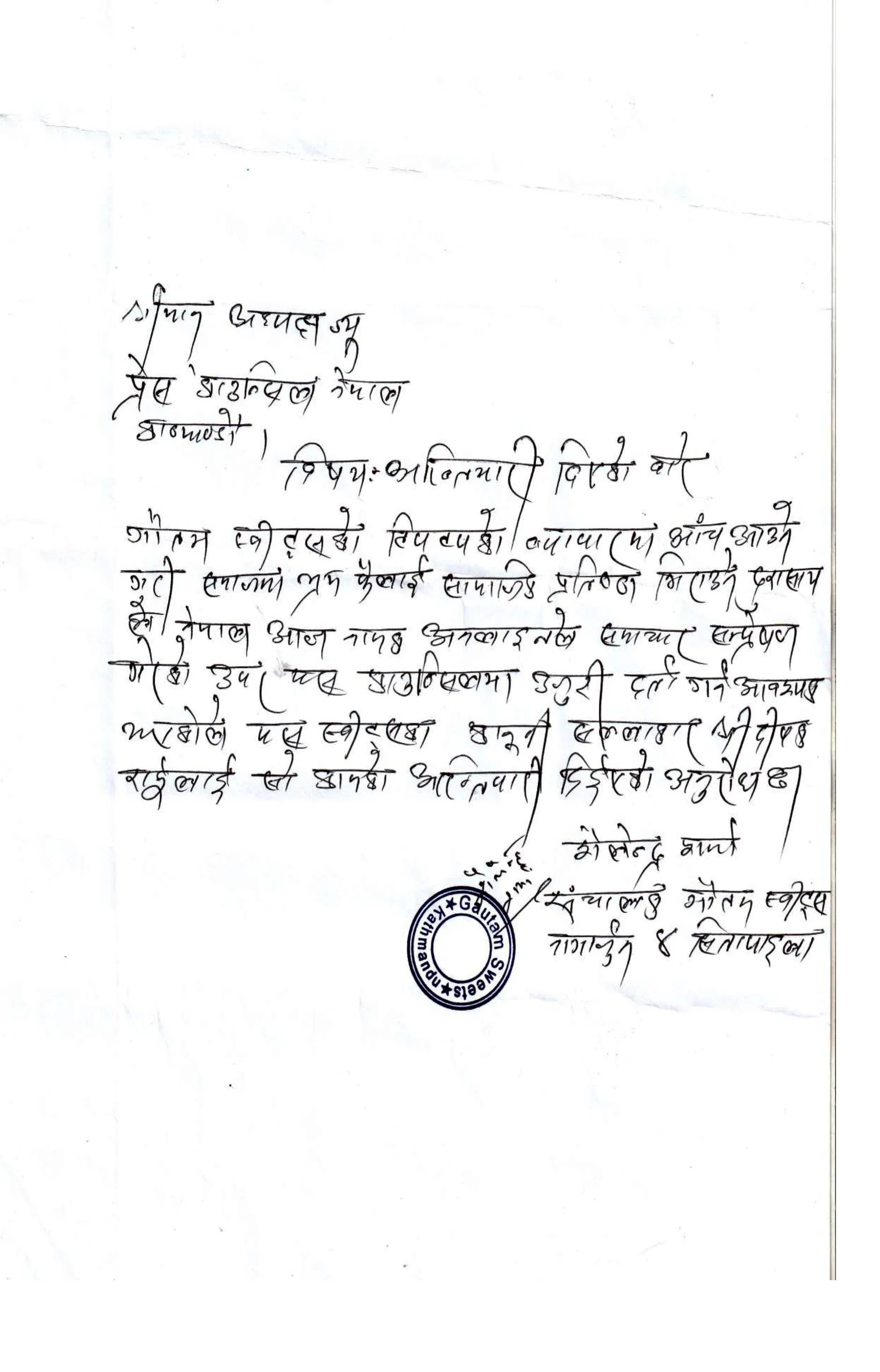
According to prevalent legal provisions, it is a natural and universally accepted legal right for any commercial firm or individual to present their claims or delegate authority through a legal advisor or representative. However, from a procedural standpoint, a strange legal flaw is evident here. Although the power of attorney granted by proprietor Shailendra Sharma to Deepak Rai bears the official seal of the company, the date on which the authority was granted is not mentioned. In a situation where a clear date is considered mandatory on legal documents and powers of attorney, submitting a dateless authorization letter appears procedurally flawed.
Journalistic Code of Conduct on Name Changes and Source Protection
In Tip Top's rebuttal letter, objection was raised over the use of pseudonyms such as 'Delta' and 'Alpha' instead of mentioning the real names of individuals who placed orders or shared their experiences.
However, international investigative journalism standards and the Nepal Press Council Code of Conduct grant media the clear right to protect the privacy of information sources and general consumers. To protect ordinary citizens sharing bitter experiences against commercial houses or powerful parties from potential mental pressure, threats, or legal hassles, changing names 'with the source's consent' is a universally accepted norm of investigative journalism. Keeping identities confidential in consideration of consumer safety is entirely in line with the spirit of journalism.
Claim of Rs 5.0 Million Loss and Search for Scientific Evidence
In the rebuttal letter, a question of compensation has been raised claiming that Tip Top suffered commercial damage equivalent to Rs 50,00,000 (fifty lakh rupees) due to the content published on Nepal Aaja.
Viewed from a media review perspective, the claim of Rs 5.0 million in commercial loss does not appear to be based on objective and scientific evidence. By what percentage did sales drop following the publication of the news compared to the previous month or previous year? Did customers stop visiting Tip Top because of the news itself or due to other market factors? No audit report or financial audit data has been presented regarding this. Claiming such a large financial loss arbitrarily without solid financial evidence and scientific indicators cannot be substantiated legally or commercially.
Context of Other Firms and Tip Top's Strange Objection
While the news published on Nepal Aaja reviewed recent incidents concerning stale and inedible items from Pathao Food, Sultan Biryani, and Sangam Sweets, Tip Top was merely cited as a decades-old historical context regarding food safety. However, in the rebuttal letter sent by Gautam Sweets, instead of focusing on its present business facts or history, an objection was raised over its logo appearing in the article's lead image while bringing forward the context of inedible goods found at other firms or companies. Tip Top adopting a defensive stance in its rebuttal over another company's inedible items and services, and making that the primary issue to raise questions, appears quite unusual from journalistic and legal review perspectives.
Historical Context and Present Market Reality
In its rebuttal, Tip Top objected that news regarding inedible and stale items found at another firm or company was placed at the forefront of the article attached with its logo and name.
The main point to clarify here is that the previous news on Nepal Aaja nowhere claimed that Tip Top is currently selling stale or foul-smelling food. While reviewing recent incidents involving Pathao Food, Sultan Biryani, and Sangam Sweets, Tip Top was merely recalled as a historical context in Nepal's food safety. The famous incident decades ago where a rat was found inside a Tip Top samosa (an incident that was even satirized in the then-popular comedy teleserial 'Tito Satya') had become an important precedent in the history of Nepali consumer rights.
Looking at current market realities, consumers share experiences and reactions regarding Tip Top's excessive pricing rather than the minimum quality of its food. Therefore, old historical contexts and debates over current market pricing should not be linked with the sale of inedible items.
Consumer Rights, Legal Remedies, and Responsible Journalism
Nepal Aaja media organization has always stood firmly in favor of a healthy market, responsible business, and the constitutional rights of consumers. Our intention was not, and is not, to tarnish the commercial reputation of any traditional or major sweet shop.
However, initiating public debate on issues linked to consumer health and food safety and raising awareness among citizens is the duty of the media. We respectfully accord space to the rebuttal submitted by Gautam Sweets (Tip Top). Furthermore, the role of responsible journalism in protecting consumer rights, ensuring transparent legal processes, and guaranteeing access to quality food items will continue uninterrupted.
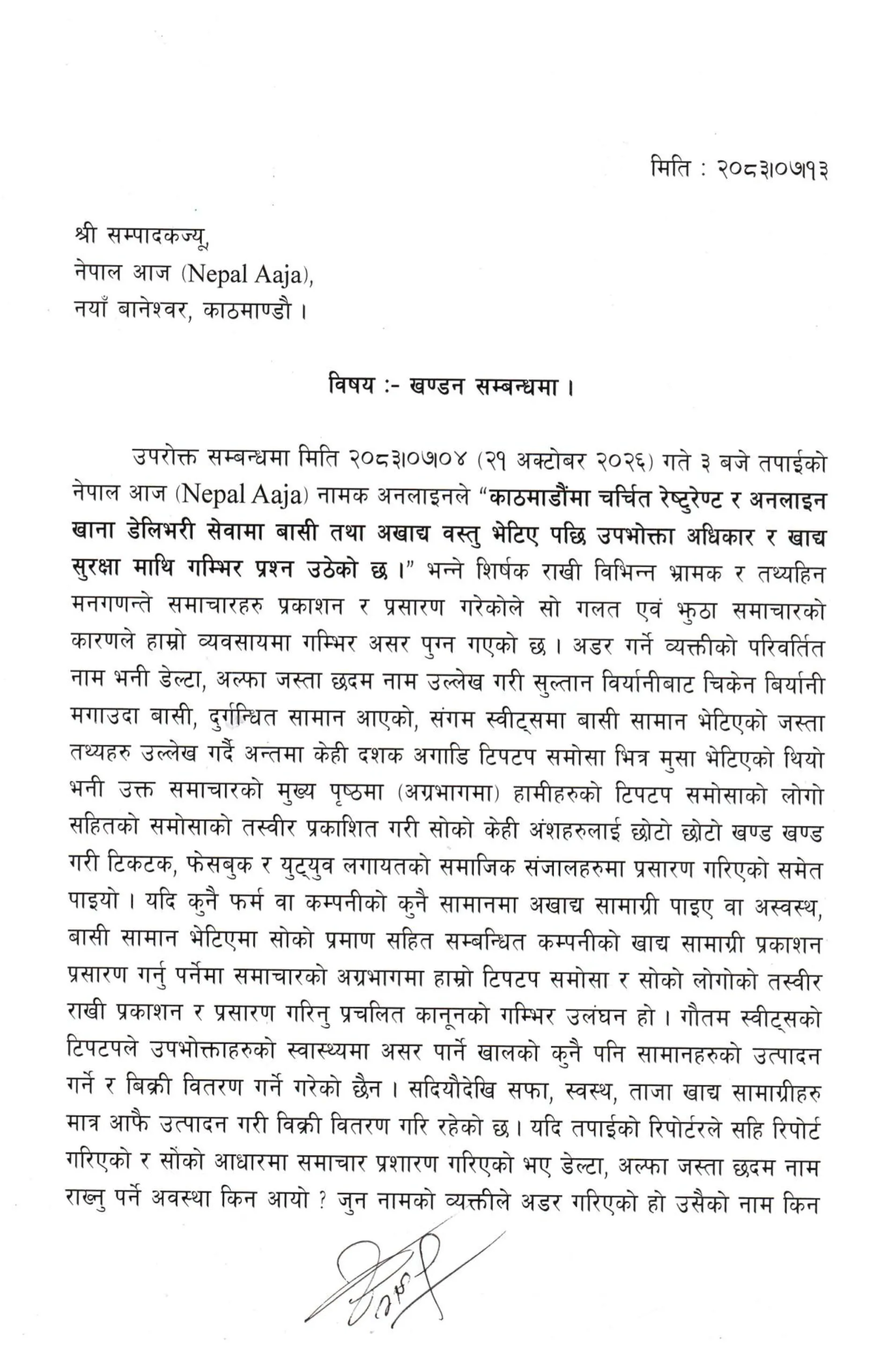
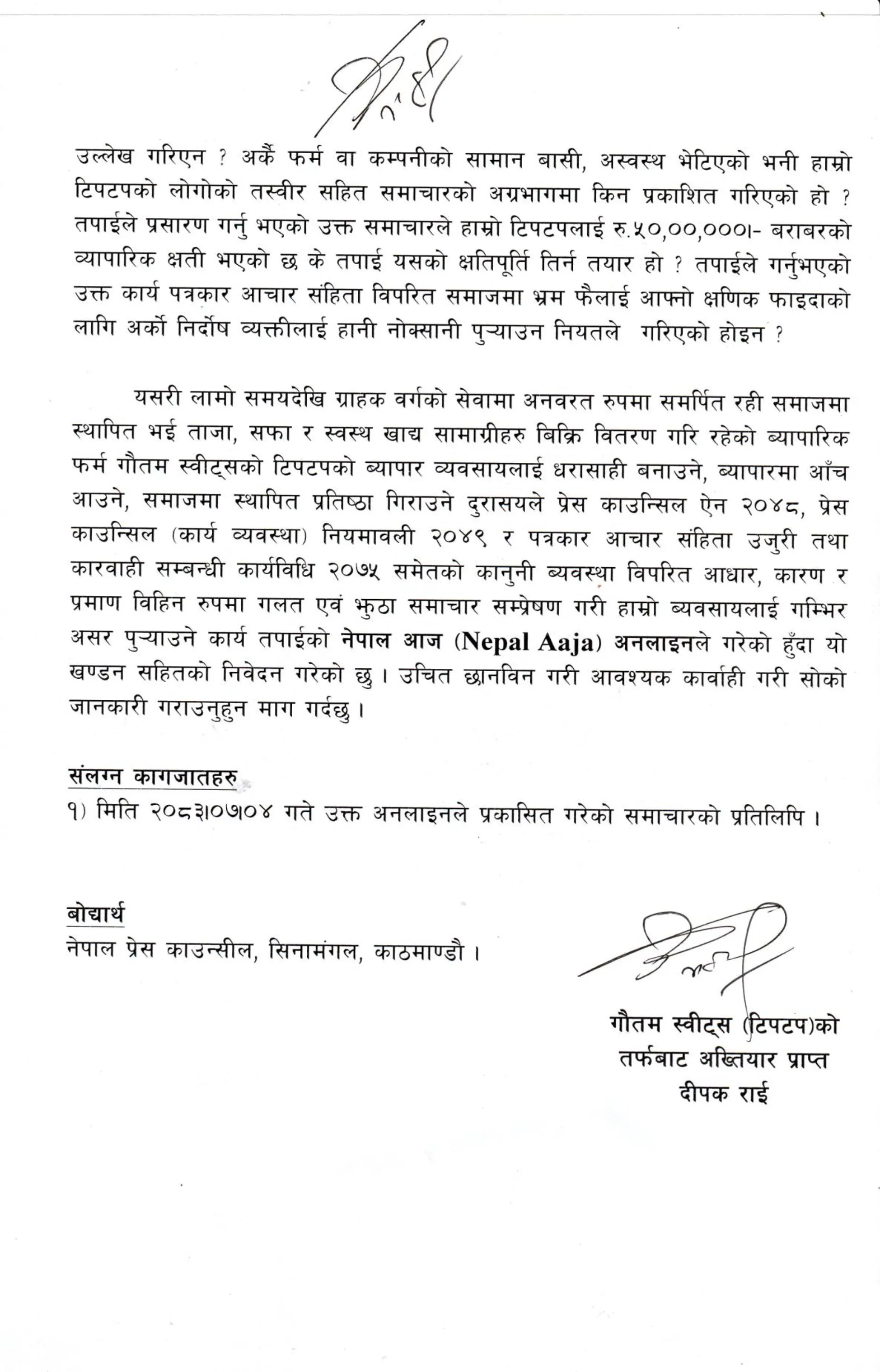
Full Text of the Rebuttal Letter Sent by the Legal Advisor of Gautam Sweets:
Page 1
Date: 2083.07.13
To the Editor, Nepal Aaja, Naya Baneshwor, Kathmandu.
Subject: Regarding Rebuttal.
In connection with the above subject, on 2083.07.04 at 3 PM, your online media outlet Nepal Aaja published and broadcasted various misleading, factless, and fabricated news items under the title "Serious questions raised over consumer rights and food safety after stale and inedible items were found in famous restaurants and online food delivery services in Kathmandu," due to which false and untrue news our business has been severely affected. Mentioning changed names of ordering individuals such as Delta and Alpha, stating facts like receiving stale and foul-smelling items upon ordering chicken biryani from Sultan Biryani, stale items found in Sangam Sweets, and finally stating that decades ago a rat was found inside Tip Top samosa, you published a photograph of samosa along with our Tip Top Samosa logo on the main page of said news and broadcasted short clips of it in fragments across social media including TikTok, Facebook, and YouTube. If inedible items or unhealthy, stale goods are found in any firm or company, the food items of the concerned company should be published/broadcasted with proof; instead, placing the photograph of our Tip Top samosa and its logo at the forefront of the news and publishing/broadcasting it is a serious violation of prevailing laws. Gautam Sweets' Tip Top has not produced or distributed any goods that adversely affect consumer health. It has been producing and distributing only clean, healthy, and fresh food items for generations. If your reporter had reported truthfully and news was broadcasted based on that, why did the situation arise to use names like Delta and Alpha? Why was the name of the person who actually placed the order not mentioned? Why was a story about stale and unhealthy items of another firm or company published at the forefront with our Tip Top logo photo?
Page 2
Your broadcast of said news has caused commercial damage equivalent to Rs 50,00,000 to our Tip Top; are you prepared to pay compensation for this? Was not this action of yours carried out in violation of the journalist code of conduct to spread confusion in society for your momentary gain with the intent of harming another innocent party? Therefore, since your Nepal Aaja online has committed an act that severely impacts our business by disseminating false and untrue news without basis, reason, or evidence in violation of legal provisions including the Press Council Act 2048, Press Council Regulations 2049, and Journalist Code of Conduct Complaints and Action Procedure 2075, with malicious intent to derail the business, harm trade, and tarnish the established social reputation of Gautam Sweets' Tip Top—a commercial firm continuously dedicated to serving customers for a long time and distributing fresh, clean, and healthy food items—I have submitted this application along with this rebuttal. I request you to conduct a proper investigation, take necessary action, and inform us accordingly. Enclosed Documents:
Copy of the news published by the said online outlet on date 2083.07.04.
Cc: Nepal Press Council, Sinamangal, Kathmandu.
Authorized on behalf of Gautam Sweets (Tip Top): Deepak Rai
Read this as well:
'Eat Stale Food and Stay Healthy': The Plight of Nepali Consumers