


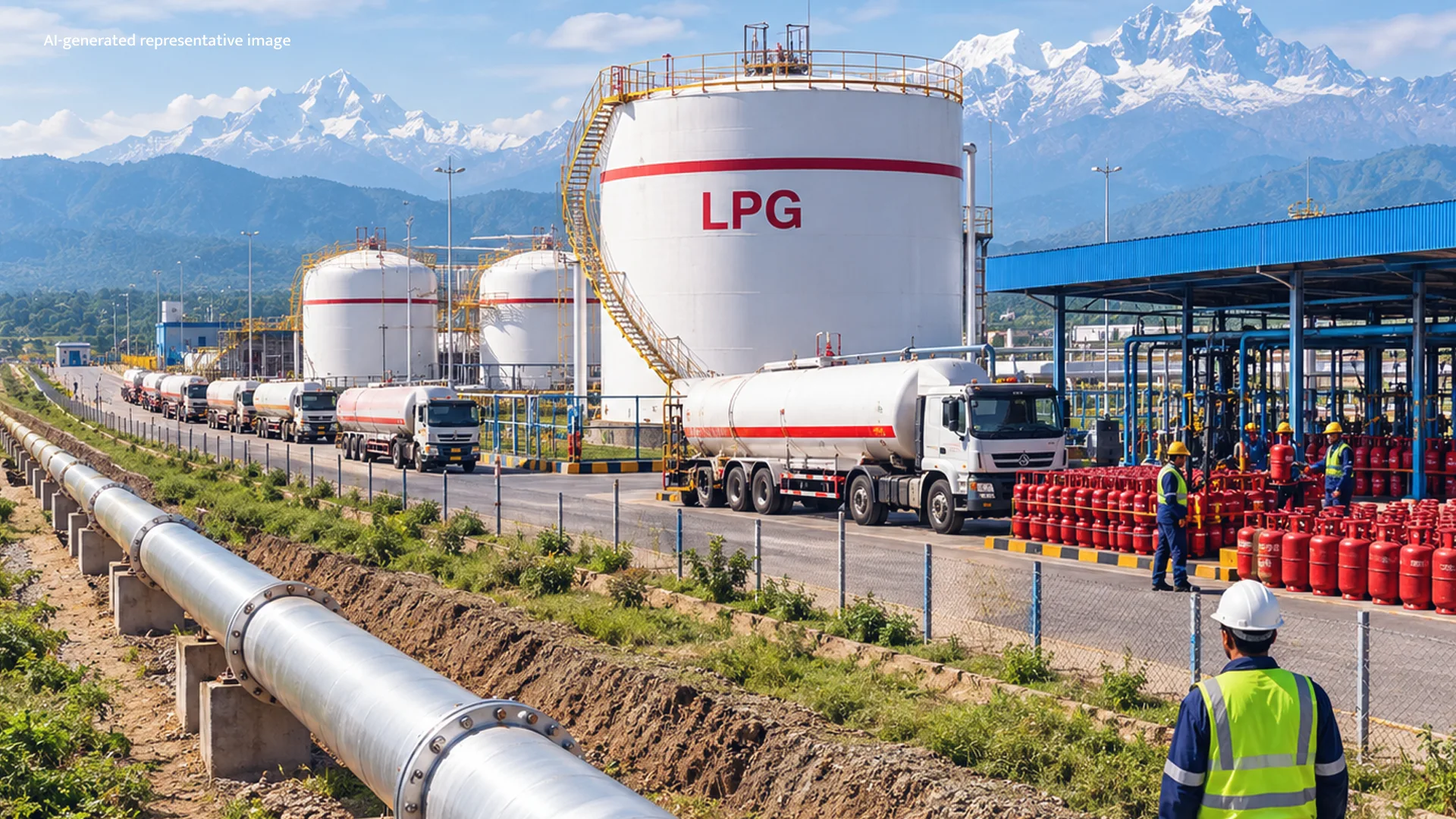
Repeated highway disruptions and natural calamities will no longer leave Nepalese kitchens without cooking fuel, as Nepal Oil Corporation (NOC) accelerates a landmark cross-border Liquefied Petroleum Gas (LPG) infrastructure project. Designed to fortify national energy resilience, the initiative features a 131-kilometer direct pipeline from Motihari, India, alongside a state-of-the-art 50,000-metric-ton storage and bottling hub in Sarlahi district, according to reports by Hindusthan Samachar.
The multi-billion rupee investment targets Nepal’s vulnerability to transportation bottlenecks. Currently, with virtually zero government-owned gas reserves, even brief highway closures lasting two to four days cause severe nationwide LPG shortages. Recent disruptions—such as the devastating August 26 Bhotekoshi floods that severed highway connections and damaged hydropower assets—underscored the urgent necessity for robust strategic reserves. Once fully operational, the Sarlahi facility will store enough gas to meet the entire nation’s domestic consumption for an entire month.
Beyond guaranteeing supply continuity, the infrastructure will fundamentally alter the economics of Nepal’s fuel sector. The country presently imports its entire LPG supply via 500 to 700 Indian bullet tankers traveling long distances from Indian refineries in Barauni, Durgapur, Mathura, and Paradip—trips spanning up to 1,300 kilometers and taking as long as a week. According to Binit Mani Upadhyaya, Head of NOC's LPG and Aviation Department, bypassing these long-haul road journeys via direct piping will save Nepal approximately NPR 6 billion each year in freight costs alone.
The proposed complex in Sarlahi, to be built across more than 14 bighas of land already owned by NOC, will feature three fully automated functional units: a 50,000-ton storage depot, a bottling plant capable of filling 25,000 cylinders daily, and a high-capacity gantry system to load 100 bullet tankers per day. The pipeline itself will follow the existing Motihari–Amlekhgunj petroleum corridor up to Pathlaiya in Bara district, before extending 62 kilometers eastward to Sarlahi. Construction will employ advanced Horizontal Directional Drilling (HDD) to safely pass pipeline infrastructure beneath riverbeds along the route.
The enterprise represents a deepening bilateral energy partnership between Nepal and India, initiated during the 5th Joint Working Group meeting in New Delhi and executed through a dedicated B2B committee between NOC and Indian Oil Corporation (IOC). With land soil tests submitted and coordinate survey reports finalized for IOC’s technical design team, the preparation of the Detailed Project Report (DPR) is rapidly advancing.
Estimated to cost between NPR 25 billion and NPR 30 billion, final funding mechanisms—including potential grant assistance from the Government of India or alternative financing structures—will be determined at executive government levels following DPR completion. In addition to curbing capital flight, the operational facility will transition domestic distribution to Nepali transport operators, serving 58 private bottling plants and over 15 million active household cylinders nationwide while creating vital local employment opportunities.