



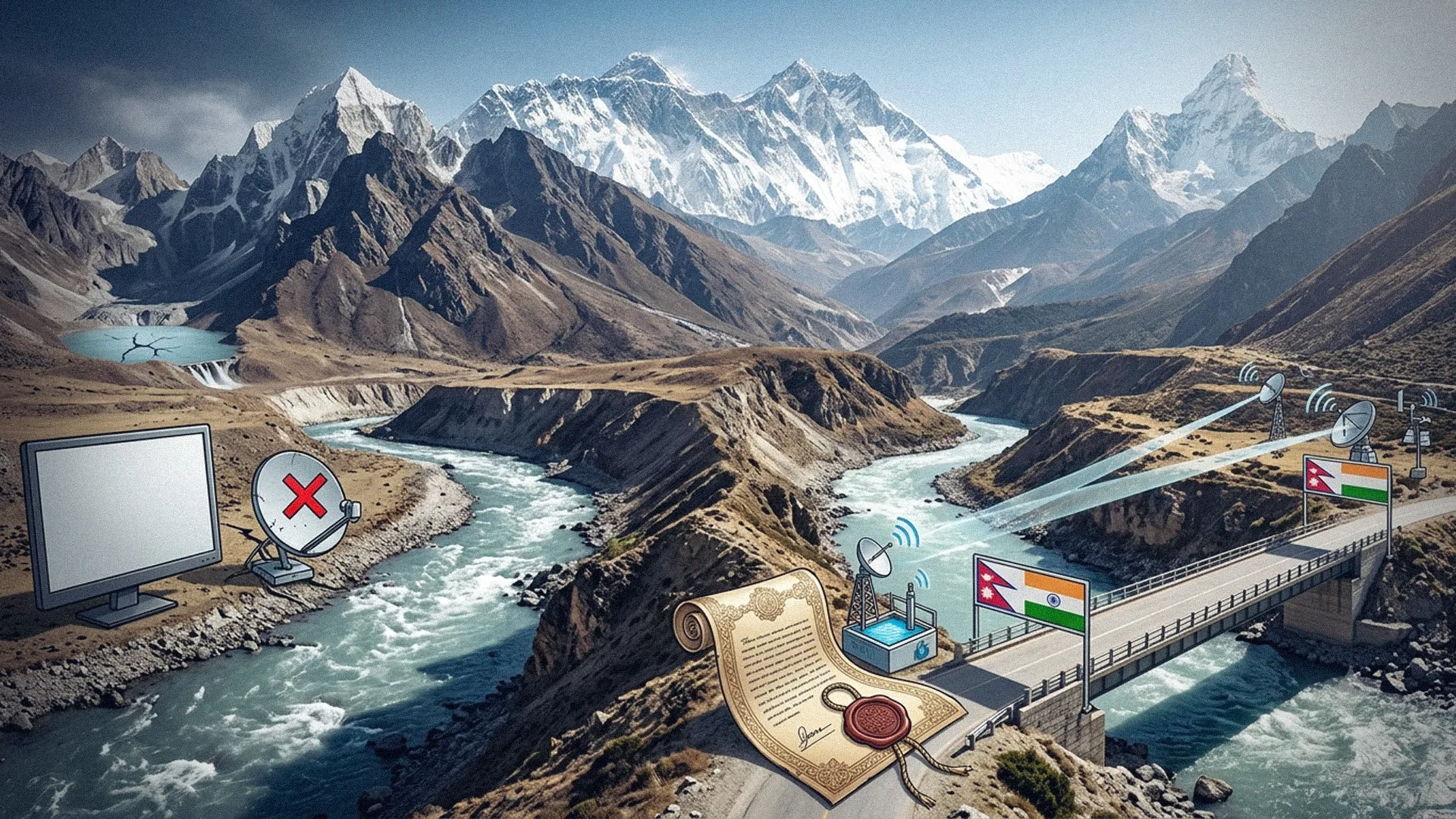
SB Shah - Most of Nepal's major river systems are transboundary in nature. Rivers such as the Koshi, Gandaki, Karnali, and Mahakali originate in the Himalayas and flow through Nepal into India. Therefore, water resources have long been a diplomatic and strategic issue in Nepal–India relations.
Formal documents such as the Koshi Agreement, Gandak Agreement, and Mahakali Treaty exist with India. Even the Water and Energy Commission Secretariat of the Government of Nepal has formally recorded these agreements/treaties related to the Koshi, Gandak, and Mahakali.
The Koshi Agreement was signed in 1954 and subsequently amended. The Gandak Agreement took place in 1959, while the Mahakali Treaty was signed in 1996. These agreements cover topics such as irrigation, flood control, hydropower, and river utilization.
This does not mean that all agreements with India are free of controversy for Nepal. Rather, issues regarding the benefits and losses, water utilization, inundation, project operation, and Nepal's share under the Koshi, Gandak, and Mahakali agreements have been debated in Nepal for a long time.
However, at least formal legal structures, joint mechanisms, and practices of hydrological information exchange for river management are comparatively developed with India. India has stated that flood forecasting and early warning systems are operational for rivers flowing from Nepal to India, and discussions take place through various levels of water resource mechanisms between the two countries.
Why is the Situation on the China Side Different?
In Nepal–China relations, numerous agreements and understandings have been reached regarding roads, trade, infrastructure, energy, border management, and other subjects. However, there is no comprehensive water treaty covering the sharing of transboundary river waters, multipurpose utilization of rivers, potential impacts of dam construction, flood control, and mandatory hydrological information exchange.
What makes this issue particularly sensitive is that several rivers originating in Nepal's northern Himalayas enter Nepal after flowing through China's Tibet region. The major tributaries of the Koshi system originate in Tibet, while river systems including the Bhote Koshi/Sun Koshi and Trishuli also have direct geographical links with Tibetan territory. The Koshi ultimately joins the Ganges in India.
For this reason, natural or human activities occurring in the upper riparian areas can impact Nepal's settlements, roads, bridges, hydropower projects, and other infrastructure located in the lower riparian areas.
What Should Be Understood by 'Water Attack'?
Here, it is appropriate to understand the phrase 'water attack' not as evidence of a military attack, but as a potential water security risk.
If an upper riparian country builds a large dam, diverts river flows, constructs reservoirs, or suddenly releases large quantities of water from structures, downstream countries may be impacted. However, natural floods, glacial lake outbursts, landslides, or avalanches cannot be labeled as a 'water attack' in the same sense.
Therefore, rather than making unproven accusations of 'water attacks' against China, it is more effective for Nepal to diplomatically manage potential water security risks institutionally.
Weaknesses Revealed by the Recent Rasuwa Flood
This debate has become even more relevant now. On August 26, 2026, a devastating flood associated with the Bhote Koshi/Lhende River occurred in the Rasuwa–Tibet border region. According to preliminary details, the water flow appears to have surged suddenly due to factors such as avalanches, large rock-ice landslides, and sudden river blockages. The incident caused massive human and material damage.
The most serious aspect of this incident is not merely the occurrence of the flood, but the question of how strong Nepal's capacity is to obtain immediate and reliable information regarding water conditions and potential risks in the transboundary region.
Details published today by The Kathmandu Post state that although discussions took place between Nepal and China on setting up a flood early warning mechanism, a formal agreement to implement it has not yet been reached. For this reason, there is a visible risk of early warning systems being weak when such disasters strike border regions.

Interested in this ad?
Would you like to continue to the link or provide your information for more details?
Please provide your information
To continue, please fill in your details
What Should Nepal Now Demand from China?
Nepal can immediately initiate a 'Nepal–China Transboundary River and Water Resources Cooperation Agreement' with China. Such an agreement need not be limited solely to water sharing.
It should cover at least five areas:
-
Real-Time Hydrological Information Sharing: Regular information sharing should take place regarding water levels, flow, rainfall, glacial lakes, and reservoir conditions in border rivers.
-
Flood Early Warning System: A binding mechanism is necessary to immediately inform Nepal if abnormal water levels rise, risks of glacial lake outburst emerge, or rivers are blocked by major landslides in China's Tibet region.
-
Emergency Information Sharing 'Hotline': During disasters, there should be no waiting for diplomatic correspondence. A 24-hour direct contact system should exist between the relevant water resource and disaster management agencies of Nepal and China.
-
Advance Notice on Major Infrastructure: Provisions are needed to ensure adequate prior notice to lower riparian countries when constructing large dams, hydropower projects, reservoirs, or structures altering river flows on transboundary rivers.
-
Joint Scientific Studies: Experts from Nepal and China should conduct joint studies on glacial lakes, glaciers, geographical risks, landslides, and the increasing risks of floods due to climate change in the future.
What Can Nepal Learn from Its Experience with India?
Despite debates over disputes and inequalities in relations with India, Nepal has experience with joint water resource mechanisms and flood early warning systems. India has stated that regular dialogue and flood forecasting/early warning systems are operational to mitigate floods caused by rivers flowing from Nepal.
Nepal can demand a similar mechanism from China as well—but in a more modern and scientific framework.
In other words, the subject should not be limited merely to the question: 'Why was there a treaty with India, but not with China?' The real question is: Why should there not be an equally effective arrangement with both of Nepal's neighbors to manage risks arising from transboundary rivers?
Water Resources Are No Longer Just a Matter of Development
For Nepal, rivers are not merely sources of hydropower, irrigation, and drinking water. They are also matters of national security and disaster security.
There are scientific concerns that glacier melting, risks of expanding glacial lakes, landslides, and sudden flooding events will increase with climate change in the Himalayas. The recent 2026 Rasuwa flood has brought the risk of disasters in transboundary rivers back to the surface.
Therefore, rather than demanding water sharing from China, Nepal must first ensure 'water information sharing' in the first phase. Receiving timely information on where the water comes from, how much is coming, what is happening in upper riparian areas, and what risks it may create downstream is most crucial for saving lives.
Conclusion
The time for viewing Nepal–China relations solely through the lens of trade, BRI, border points, and infrastructure is no longer sufficient. The waters of the Himalayas and the risks arising from them must also become an important agenda item in bilateral relations.
Just as formal agreements exist with India on rivers like the Koshi, Gandak, and Mahakali, Nepal must initiate the building of a comprehensive legal framework with China regarding river management. The objective of this is not to level accusations against China, but to ensure transparency, early warnings, mutual security, and disaster risk reduction between upper and lower riparian countries.
The recent disaster in Rasuwa has delivered a clear message: Nepal's water security is not merely a matter of utilizing water, but also a matter of protecting citizens from sudden risks arising from water. Therefore, alongside roads and trade, Nepal must now place 'transboundary water diplomacy' at a high priority with China.