


A school should be a place where children learn to read, discover their ambitions and prepare for the future.
In Pakistan, however, the collapse of school buildings, crumbling boundary walls and the absence of basic facilities have turned that promise into a source of danger for thousands of families.
The deaths of five men beneath a government school wall in Karachi’s Orangi Town exposed a disturbing failure of public infrastructure. Just weeks later, a far deadlier school-building collapse in Peshawar brought the crisis into even sharper focus.
These tragedies are not identical. The Karachi incident involved a dilapidated government school wall, while the Peshawar disaster occurred at a private educational institution.
Yet both raise fundamental questions about building safety, regulatory oversight and the protection of children in educational establishments. They also expose the consequences of allowing deteriorating infrastructure to persist until a preventable disaster forces public attention on the problem.
A warning ignored in Karachi
On 11 September 2026, a boundary wall at a government school in Orangi Town, Karachi, collapsed, killing five men and injuring two others.
Police told Dawn that the school was closed when the incident occurred in Sector 11.
According to police accounts, several people had gathered at the site to consume narcotics, and some were allegedly attempting to extract steel from the wall when it gave way.
The circumstances surrounding the victims do not diminish the questions raised by the collapse. Residents had reportedly warned that the boundary wall was dangerously dilapidated.
The Express Tribune subsequently reported that approximately 450 boys and girls studying at the school remained at risk because other sections of the wall were also in a precarious condition.
The incident exposed a troubling contradiction: a structure intended to enclose and protect a school had deteriorated to the point where it could no longer be regarded as safe.
The alleged removal of steel may have contributed to the immediate circumstances, but the reported condition of the wall raises broader questions about maintenance, inspections and the response to warnings.
The danger extends beyond the five deaths. Children attending the school depend on the authorities responsible for the premises to ensure that classrooms, walls and surrounding structures do not threaten their lives.
When an apparently longstanding hazard remains unaddressed, the failure reaches beyond construction and maintenance. It becomes a question of institutional responsibility.
Peshawar’s deadly school collapse
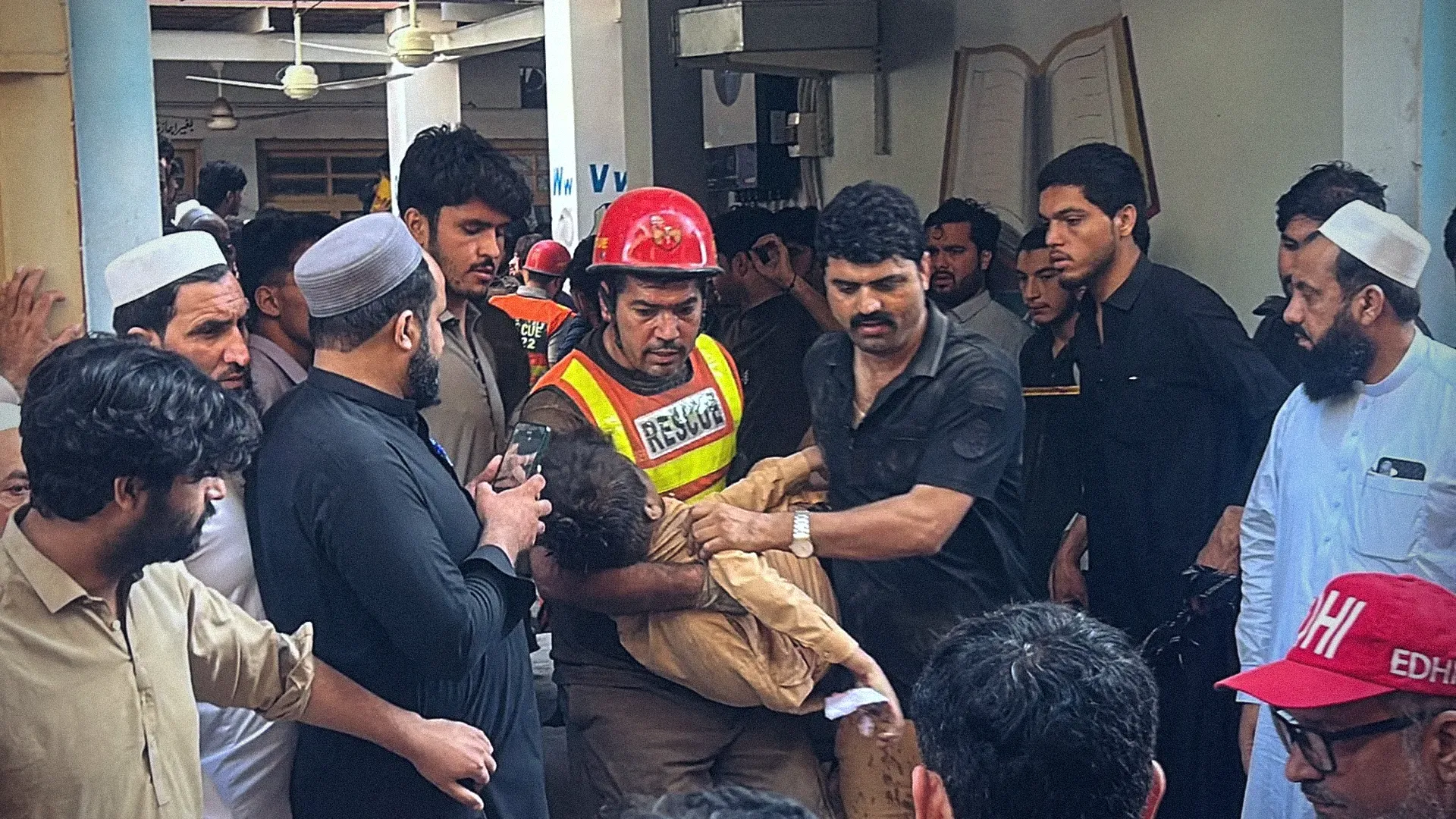
The concerns became more urgent on 15 October, when the roof of the Al-Khair Education Centre in Peshawar collapsed during morning classes.
Reuters reported that 34 children and a female teacher were killed, while 45 children sustained injuries. Most of the victims were under 13 years old.
According to the initial reporting, authorities attributed the collapse to a weak building structure and construction that had placed additional weight on an already fragile roof.
Police arrested the school's owner, and an investigation followed. Families of the victims accused the institution of disregarding known structural problems.
The Peshawar tragedy involved a private educational establishment rather than a government school, an important distinction when examining responsibility. Nevertheless, it demonstrated that the risks associated with unsafe educational buildings are not confined to one category of institution.
For parents, the distinction offers little comfort when children enter a school building and fail to return home.
The deaths also underline the importance of examining structural safety as a separate responsibility from the delivery of lessons, the appointment of teachers or the collection of fees.
The Karachi and Peshawar incidents differ in their immediate circumstances, but both have brought the physical condition of educational premises into public scrutiny.
In one case, a deteriorating wall collapsed outside school hours; in the other, a roof gave way while children were attending classes. Together, they illustrate how neglected structural hazards can have devastating consequences.
Basic facilities remain missing
The national picture provides further context. Pakistan's public schools continue to face shortages of electricity, drinking water, toilets and boundary walls, according to figures reported in the Pakistan Economic Survey 2025–26.
A report published by Dunya News in June 2026 said that 65 percent of public schools had electricity, leaving 35 percent without access to power.
Only 76 percent had drinking-water facilities, while approximately 23 percent lacked toilets. The survey also indicated that 25 percent of public schools did not have boundary walls.
These figures describe different forms of infrastructure deprivation, and not every school lacking a particular facility necessarily faces the same level of structural danger.
However, they demonstrate the scale of the deficiencies confronting the public education system.
Electricity shortages affect the usability of classrooms, particularly in extreme weather.

Interested in this ad?
Would you like to continue to the link or provide your information for more details?
Please provide your information
To continue, please fill in your details
Inadequate sanitation compromises students' daily experience, while the absence of safe drinking water creates another basic difficulty. Missing or damaged boundary walls can expose school premises to outside hazards and leave children with insufficient protection.
The deficiencies are not distributed evenly. Dunya News reported that electricity was available in only 21 percent of public schools in Balochistan and 32 percent in Sindh. Such disparities indicate that the condition of school infrastructure varies significantly across provinces.
The figures also reveal why isolated incidents cannot provide a complete picture of the problem.
A school may remain open and continue to enrol children even when essential facilities are unavailable. The existence of a functioning school on official records does not, by itself, establish that its buildings are safe or that its premises meet students' basic needs.
Financial strain behind neglect
Pakistan's education crisis is closely connected to limited public investment.
UNICEF estimates that 25.1 million children aged five to 16 are out of school, equivalent to approximately 35 percent of the country's population in that age group. Its education overview identifies persistently low public spending as a major constraint on progress.
The organisation states that education expenditure fell to approximately 0.8 percent of gross domestic product in the 2024–25 fiscal year, according to the Pakistan Economic Survey 2024–25.
It also notes that nearly 90 percent of education expenditure goes towards recurrent costs, primarily salaries, leaving limited fiscal space for infrastructure, learning materials and other improvements.
These figures do not establish that inadequate spending directly caused either the Karachi or Peshawar collapse. That determination requires building-specific investigations and evidence.
They do, however, help explain the wider environment in which maintenance and infrastructure needs compete for limited resources.
When schools lack adequate funding for repairs, the condition of buildings becomes a critical concern.
The risk is particularly serious when deterioration remains visible for extended periods or when authorities receive warnings but fail to address them. Infrastructure problems can accumulate gradually, making routine maintenance and effective inspection essential to school safety.
A crisis beyond the classroom
The consequences of unsafe schools extend beyond the immediate threat of injury or death.
Pakistan already faces considerable difficulties in bringing children into education and keeping them enrolled. UNICEF's estimates show that millions remain outside the school system, with substantial provincial disparities.
In such circumstances, the physical condition of schools becomes part of a larger question about access to education.
Families who depend on government institutions often have limited alternatives when local facilities are poorly maintained. For lower-income households, the condition of a school building can therefore shape not only a child's learning environment but also the family's confidence in the institution.
The impact is especially significant when public schools lack the most basic amenities. A building may be officially designated as an educational institution, yet its practical value is diminished when children cannot study in safe and adequately equipped surroundings.
The problem also raises questions about accountability across different levels of government and school management.
The Karachi incident concerns a government institution, while the Peshawar collapse has prompted scrutiny of a private school's ownership and structural condition.
The responsibilities differ, but both cases demand careful examination of the decisions, inspections and maintenance arrangements that preceded the disasters.
When warnings become tragedies
The collapse in Orangi Town should not be viewed solely through the circumstances that brought the wall down.
The reported warnings about its condition raise a more fundamental question: why did a school boundary become dangerous enough to kill five people and leave hundreds of enrolled children facing further risk?
Peshawar has added another devastating chapter to the debate over educational safety. The loss of 34 children and a teacher in a single building collapse has demonstrated the human cost of structural failure on an appalling scale.
Investigations must establish the precise causes of each disaster rather than treating every collapse as the result of the same failure.
Yet the broader evidence of missing facilities, low education spending and uneven infrastructure shows that the incidents have emerged against a background of longstanding pressure on the education system.
For the families who have lost loved ones, the consequences are irreversible. For children continuing to attend schools with unsafe buildings or inadequate facilities, the danger remains a daily concern.
An education system cannot be judged solely by enrolment figures, examination results or the number of institutions on official records. The safety of the children inside those institutions is equally fundamental.
When a school building becomes a source of danger rather than protection, neglect is no longer an abstract administrative failure. It is a matter of human life.