


Author: Gyanmitra
Introduction: When Dreams Become Laboratories
We spend a large portion of our lives sleeping, and a part of that sleep dreaming. During that time, we enter a strange world—where physical laws change, time becomes unstable, the deceased speak again, and we can fly. But the irony is that we mostly spend that time unconscious.
Can that time be spent with a bit more awareness?
A 2026 study from Italy's University of Trento suggests it can. In this study, 38 participants were divided into three groups. All participants wrote a daily dream diary for five weeks, performed reality checks about ten times a day, and answered questions related to dream consciousness.
The first group—the VR-experimental group—performed eight VR sessions twice a week for four weeks alongside this core practice. Each session consisted of approximately fifteen minutes of open-monitoring meditation, followed by roughly twenty minutes of interactive VR practice. In that practice, participants were placed in an environment where normal physical laws broke down—objects changed strangely, scenes altered suddenly, and counter-intuitive events occurred. Participants were taught to identify these "dream signs," perform reality checks, maintain awareness, and practice lucid-dreaming tasks like flying in subsequent sessions.
The second group—the VR-control group—also completed eight VR sessions, but their VR experience was unrelated to dreams or lucidity. They were assigned tasks like searching for hidden spheres in a visually similar, normal environment. The third group—the control group—practiced only the basic exercise of dream diaries and reality checks; they received no VR training.
In the results, the VR-experimental group reported the highest number of lucid-like dreams—meaning full lucid and semi-lucid dreams. A total of 26 such experiences were registered in that group, whereas only 11 were registered in the basic practice group and 4 in the general VR group. Thus, VR training linked to lucid dreaming was far more effective than merely experiencing VR. According to the study, the rate of lucid-like dreams in the VR-experimental group was approximately four times higher than in the group doing only basic practice.
However, it is necessary to remember that this is a small sample, self-reported, and preliminary-level study. This does not mean VR will start giving everyone lucid dreams; it means that conscious, dream-oriented practice during the day can increase the possibility of awareness in night dreams.
A Personal Confession
I too have occasionally realized within a dream that I am dreaming. That moment is remarkable—on one hand there is fear, and on the other, a kind of freedom. But the most interesting part is that even upon awakening inside a dream, the mind does not become quiet. Fear arises, desire arises, and the temptation to control emerges.
Sometimes I try to fly. Sometimes I try to escape fear. Sometimes I try to alter the dream according to my wish. But whenever I try to control, the dream becomes more unstable. And whenever I merely observe—the fear, the characters, the scene—something changes.
Therefore, I feel the true practice is not to conquer the dream, but to know one's own mind within it. Awakening in a dream does not simply mean realizing "I am dreaming." It means seeing one's own fear, greed, hope, and ego right there.
This article examines the relationship between dreams, consciousness, entropy, and AI, keeping that study at its core. But its goal is not merely to teach ways to "gain control over dreams"; its deeper question is: how can we remain aware amidst instability?
1. History: We Knew It Yesterday
Vedic and Hindu Tradition—Yoganidra
Our scriptures speak of four states of consciousness—Waking (Jagrat), Dreaming (Swapna), Deep Sleep (Susupti), and Turiya. Ordinary human beings operate within the first three states, but the yogic tradition considers the fourth state to be a deep dimension of consciousness.
In the Mandukya Upanishad, the dream state is called "Pravivikta"—the state of subtle experience and enjoyment. In the Yoga Sutras, Patanjali states: "Swapnanidrajnanalambanam va" (1.38)—meaning the knowledge of dreams and sleep can also serve as an object of meditation and samadhi.
In the Hindu tradition, "Yoganidra" is also a form of the Goddess—who holds creation in sleep while remaining aware herself. This symbol carries a profound truth: sleep and awareness are not enemies of each other.
Buddhist Tradition—Dream Yoga
In Tibetan Buddhist tradition, dream yoga is considered not just a night experience, but a deep study of consciousness. In the tradition associated with Tilopa and Naropa, "Milam" or Dream Yoga is one of the Six Yogas of Naropa. In this tradition, dreams, sleep, death, and bardo—the intermediate state after death—are viewed as different forms of the same consciousness.
Its purpose is not merely to gain power in dreams, learn to fly, or fulfill desires. Its core objective is to observe the instability of dreams to recognize attachment, fear, and self-grasping. The fear, joy, dread, and attraction seen in dreams change in a moment. Learning to recognize this instability helps a person understand the nature of their own mind.
The Tibetan tradition considers waking life to be a form of extended dream as well. Even in the life we call "real," fear, greed, hope, and ego constantly surround us. If we learn to maintain awareness in dreams, we can maintain consciousness during life's crises, changes, and instabilities like death.
Bardo and the Journey After Death
In the Tibetan tradition, death is not considered an end; it is regarded as a major transition of consciousness. This transition is called Bardo—meaning the "intermediate state." Bardo Thödol, known in the world as 'The Tibetan Book of the Dead', describes the journey of consciousness from the moment of death to rebirth. The central teaching of this text is that the intense lights, terrifying forms, sounds, and visions seen after death are not external entities; they are projections of one's own mind. Just as we create a world from our own mind in a dream, so too in the Bardo, consciousness experiences the states of its own mind.
For this reason, Dream Yoga is linked to preparation for death. Learning to recognize "this is a dream" in a dream is preparation to recognize "this is a projection of my mind" in the Bardo. A dream here is not merely night imagination; it is a training ground for the deep practice of death and consciousness.
The Art of Dying
In the Tibetan tradition, death is not merely a physical end, but the most important moment of consciousness. Thus, death is not viewed as an event to be feared, but as an art that can be practiced. This is called 'The Art of Dying'. In this view, lifelong practice—meditation, dream yoga, compassion, and self-observation—helps maintain consciousness at the moment of death. One who has learned to know the mind in life fears less at the time of death because they have already learned to observe fear, greed, and instability. There is a deep message here: preparation for death does not happen at the end of life, but on every single day of life. And one training ground for that preparation is the dream.
Dreams in Nepali Geography
In Nepal's cultural geography, dreams are not merely night imaginations; they are experiences connected to consciousness, death, and existence. In Himalayan Buddhist tradition, Dream Yoga is still alive, where dreams are considered a path to self-knowledge.
In our society, dreams are often viewed as auspicious or inauspicious signs. Some feel dreams foretell the future. Some feel characters seen in dreams bring messages. But this article presents dreams not merely as a medium of prophecy, but as a domain for the study of consciousness.
In Nepal's tantric and Buddhist traditions, dreams, death, and consciousness are deeply interconnected. Here, a dream is not considered just a nighttime event; it is considered a doorway into the depths of the mind. Therefore, the meeting between modern lucid dreaming and traditional dream yoga is not just a matter of foreign science for Nepal—it is also a re-reading of our own cultural memory.
The Meeting of Modern Lucid Dreaming and Tradition
Modern science studies lucid dreaming mainly as a psychological and neuroscientific phenomenon. But the Tibetan tradition connects it to a larger question—what is consciousness? What happens after death? How do we free ourselves from the world created by the mind?
These two perspectives are not identical, but they can complement each other. Science seeks the "how"; tradition raises the questions of "why" and "for what." Thus, lucid dreaming is not merely nighttime entertainment—it is a modern investigation linked to ancient questions of consciousness, death, and self-knowledge.
Modern Science—From Van Eeden to LaBerge
The study of lucid dreaming in modern science began relatively recently. In 1913, Dutch psychiatrist Frederik van Eeden used the term "lucid" in his analysis of dreams. In 1975, Keith Hearne developed a method of signaling the laboratory using eye movements from within a lucid state. Later, Stephen LaBerge popularized techniques such as MILD and WBTB.
The Trento VR study is a new link in this long journey—where ancient meditation, modern psychology, and immersive technology meet in one place.
2. What Happens in the Brain?—The Neuroscience of Entropy
During ordinary REM dreaming, certain areas of the brain are highly active while the activity of other regions decreases.
Prefrontal Cortex activity decreases: The area responsible for logic, self-observation, and reality-testing is less active. Therefore, even when impossible events occur in a dream, we do not ask—"Is this possible?"
Visual Cortex and Limbic System become active: Regions related to imagery, sensation, and emotion are strong. Hence, dreams are vivid, intense, and emotional.
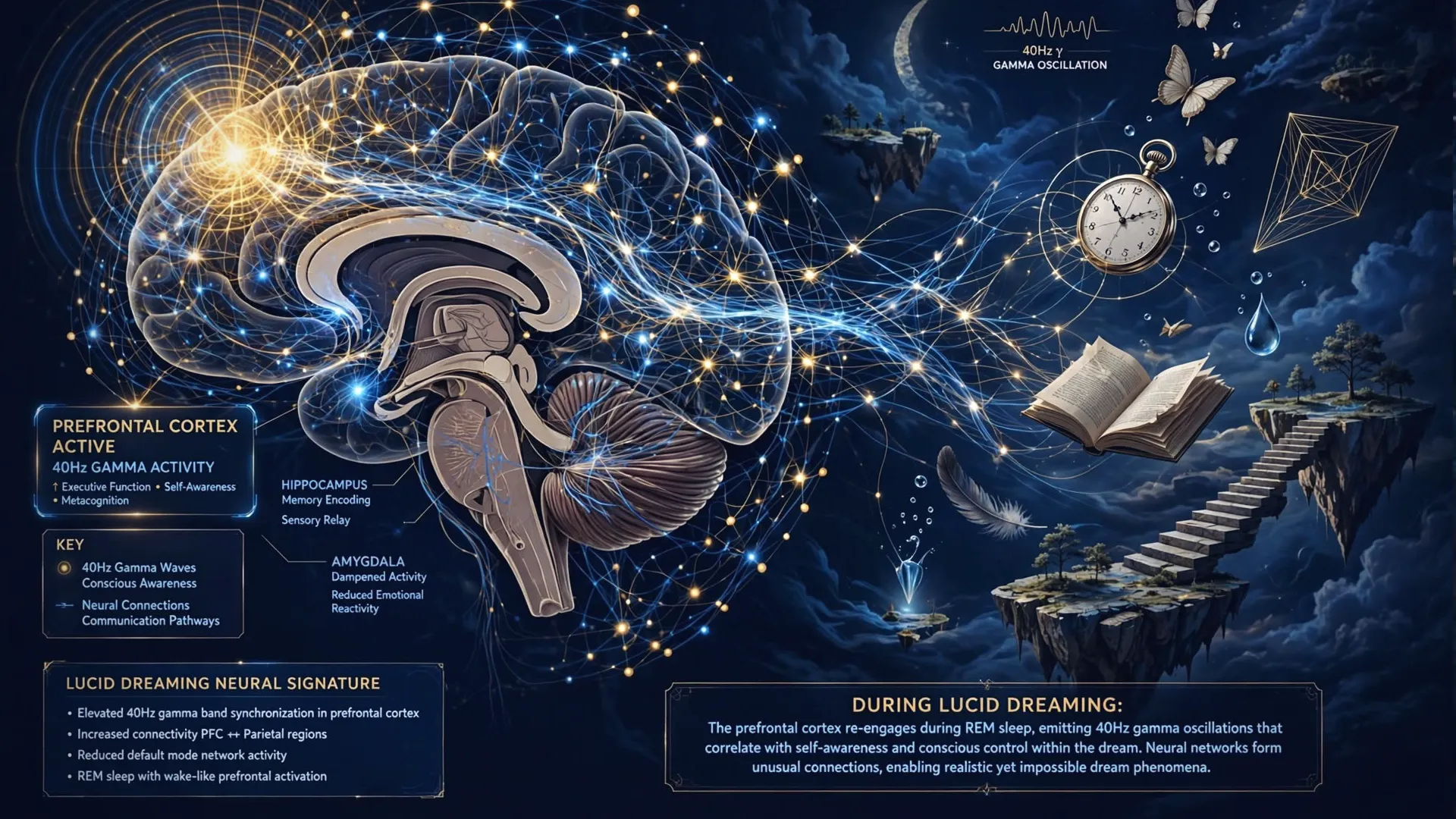
In Lucidity, Frontal Activity rises again: Studies indicate that in lucid REM, gamma activity around 40 Hz and coherence in the frontal region increase. This suggests that critical and metacognitive consciousness reactivates during lucidity.
The Trento VR practice created an unusual daytime environment—where physical laws were unstable, scenes shifted, and participants were conditioned to ask, "Is this real?" At night, when similar incongruities appear in dreams, the trained mind can automatically ask—"Am I dreaming?"
Here, "entropy" is not used strictly in the mathematical physics sense. Here, it denotes mental uncertainty, unpredictability, expansion of possibilities, and instability of rules. Dream, in this sense, is an experience of entropy; consciousness is the art of finding direction and meaning within it.
3. Why Pursue Lucid Dreams?
The most practical potential of lucid dreaming has been observed in relation to nightmares. Some studies suggest it may help reduce the frequency, intensity, and psychological distress of nightmares. However, this remains a developing field. Available studies are small, methodologically varied, and sometimes inconsistent; thus, it is appropriate to view lucid dreaming not as an independent treatment method, but as a potential adjunctive practice.
Potential Benefits of Lucid Dreaming:
-
Helps alter the relationship with nightmares
-
Ability to observe fear and anxiety
-
Experience of creativity and problem-solving
-
Psychological preparation for death, change, and uncertainty
However, there is an important limitation—lucidity does not always confer control. Many lucid dreamers cannot alter dreams according to their wish; in some cases, unsuccessful induction attempts can even lead to more uncomfortable or unpleasant dreams.
4. Observation, Not Control
The objective of lucid dreaming is not merely to fly in dreams, become a deity, or fulfill desires. Its deeper practice is to observe the instability of dreams.
When we observe in a dream that fear, greed, joy, and dread change in a single moment, we begin to realize that the "stable" experiences of waking life are equally changeable.
An Example: Imagine you are crossing a river in a dream. Suddenly the water turns red, and you realize, "This is a dream." At that moment, you have two paths: one, to run away in fear; two, to observe that fear. If instead of fleeing, you observe the water, the dream changes. But more importantly—your relationship with fear changes.
Here lies the true power of lucid dreaming—not to conquer the dream, but to know oneself within the dream.
Nolan's Film Inception and Reality
After Christopher Nolan's Inception was released, lucid dreaming gained global attention. In the film, characters create dreams within dreams, alter dream rules, and attempt to plant ideas in others' minds. This gave audiences an exciting question—is complete control in dreams possible?
In real science, the picture is somewhat different. In lucid dreaming, a person can recognize "I am dreaming" and can sometimes influence certain aspects of the dream. However, the ability shown in the movie—multiple people entering the same dream, planting ideas in another's dream, or traveling through multiple dream layers—is not scientifically proven.
Yet one aspect of Inception is quite profound—the totem. The film's characters use a special object to test whether they are in a dream. This closely resembles real-life reality checks. The only difference is: in the film, the totem provides proof of the external world, whereas in real practice, we question our own consciousness—"Am I dreaming right now?"
In this sense, Inception asks us questions not about dreams, but about our relationship with reality. And that very question is at the center of this article—how can we remain aware amidst instability?
5. Practical Laboratory: What Can Be Done Starting Today?
Lucid dreaming can be practiced even without VR. However, it should not be overdone at any time; it must be practiced in a balanced manner.
A) Dream Diary—Valuing Dreams Upon waking in the morning, try to recall dreams for 2 minutes without opening your eyes. Then briefly write:
"Today I saw myself crossing a river. The water was red. I was flying."
The habit of writing increases dream recall capacity because the brain starts treating dreams as important information.
B) Reality Check—Testing Reality During the Day Form a habit of consciously checking reality several times throughout the day:
-
Look at your hand: In dreams, hands or fingers may appear unusual.
-
Look at a watch or mobile phone twice: In dreams, time and text can be unstable.
-
Read a short sentence and re-read it: In dreams, letters can change.
-
Try breathing while pinching your nose: In dreams, the sensation of breathing can be unusual.
The purpose of these practices is not to cause fear; it is to train the mind to ask the question: "Where am I right now?"
C) MILD—Pre-Sleep Intention
Before sleeping at night, hold a clear intention in mind: "Tomorrow I will remember my dream, and when I am in a dream, I will recognize that I am dreaming."
This is not mere self-hypnosis; it is a method to train prospective memory—the ability to remember an intention to perform an action in the future. In LaBerge's tradition, MILD is considered one of the effective methods.
In the Trento study, dream diaries, reality checks, meditation, and VR were combined.
An Easy Way to Start: A 7-Day Practice
If you wish to begin this practice, do not do everything at once. Start in a small, regular, and balanced manner.
| Day | Practice |
| 1–2 | Recall dreams immediately upon waking in the morning and write a short dream diary |
| 3–4 | Perform reality checks 3–5 times during the day |
| 5 | Make the MILD intention before sleep |
| 6 | Meditate for 5 minutes and continue daytime reality checks |
| 7 | Review the week's experiences—analyze which sign revealed the dream and under what conditions the dream became clear |
The purpose of this practice is not to quickly achieve lucid dreams. Its purpose is to bring conscious awareness to your relationship with dreams. On some days nothing may appear; on some days only dream recall will improve. That too is progress.
6. VR: A Doorway, Not the Destination
VR makes practice convenient and engaging. By creating artificial uncertainty during the day, it trains the brain to ask, "Is this real?"
However, VR is not a replacement for true self-knowledge. Excessive screens and immersive technology can affect sleep, meditation, and one's relationship with reality. VR assists practice, but it cannot fully replace mental discipline, ethical sensitivity, and guidance from a teacher. Technology is a doorway, not the destination.
7. Future: When Signals Are Sent into Dreams
In the future, technology will evolve beyond VR to influence dreams by delivering sound, light, or olfactory signals during sleep. This is known as Dream Engineering.
One method is Targeted Lucidity Reactivation. In this technique, a sound or cue is paired with the practice of saying "I am dreaming" before sleep, and that same cue is replayed during REM sleep. The objective—to recognize the signal inside the dream and trigger lucidity.
Some studies show such signals can increase the probability of lucid dreams, though results are not always uniform and signals can sometimes disrupt sleep. But the direction is clear: dreams are no longer just personal experiences; they are becoming a domain for potential technology.
Here a major ethical question arises—does anyone have the right to enter another person's dream? With possibilities of showing advertisements, inducing fear, or psychologically influencing someone within dreams, this question is not merely philosophical; it becomes a future ethical dilemma.
Dreams are human consciousness at its most vulnerable state. Therefore, Dream Engineering must be regarded not merely as a new technology, but as an ethically highly sensitive technology.
8. Risks and Ethics: All That Glitters Is Not Gold
Lucid dreaming can be exciting, but it should not be turned into a game of control or a tool for spiritual ego.
-
Sleep Disruption: Repeatedly waking up at night to write dreams or attempt inductions can lower sleep quality, affecting daytime alertness, memory, and stress levels.
-
Sleep Paralysis: Some studies indicate that frequent lucid dream induction practitioners may experience an increase in sleep paralysis or unusual sleep-wake transitions. Rates vary by individual and method.
-
Dissociation or Derealization: Certain sensitive individuals may feel ongoing instability, fear, or detachment during the day, feeling "Am I real?" If such experiences occur repeatedly, a mental health professional should be consulted.
-
Mental Health Sensitivity: Individuals with conditions such as psychosis, schizophrenia, or bipolar disorder should exercise special caution before attempting lucid dream induction, as it may increase the risk of confusion or mood instability in some cases.
-
Spiritual Ego: The Tibetan tradition views feeling "I am the controller of everything" upon gaining power in dreams as a major obstacle. Thus, the goal of practice is not to conquer dreams, but to observe them.
Therefore, intensive practice should be limited to 2–3 times a week. If there is anxiety, trauma, severe sleep problems, or mental instability, consulting a qualified physician or psychologist before starting practice is advisable.
9. Limitations of Evidence
The greatest challenge in this field is the limitation of evidence. Many studies feature small sample sizes, self-reports, and lack of adequate replication. Therefore, it is appropriate to view lucid dreaming not as a miraculous solution, but as an evolving area of research.
Dreams themselves are subjective experiences. Thus, what an individual experiences remains central to their study. But for this very reason, objective testing of results is difficult. What one person calls a "lucid dream" may for another be merely a vivid dream.
Hence, maintaining enthusiasm on this topic is good, but exaggeration should be avoided. Lucid dreaming remains a field of research—not a proven medication, not a measure of spiritual success, and not a method that works identically for everyone.
Final Dialogue: Entropy, AI, and Awareness
"Disorder within order" is not merely a formula of physics; it is also the structure of life.
From morning to night, we seek order—we tidy our homes, arrange files, set schedules, and define relationships. We feel that peace will arrive once everything is controlled.
Yet at night in dreams, that very order collapses. House walls become gardens, departed people speak again, and we fly. Dreams open up our controlled mental structures.
An ordinary person fears uncertainty—when illness, failure, death, or unexpected events strike, they feel life has shattered. But an aware individual does not treat disorder as an enemy. They do not seek to erase disorder; they light a small lamp within disorder.
Recognizing "I am currently in instability" is itself the greatest inner order.
This same question applies to AI. AI itself is an ocean of vast data, countless possibilities, words, images, and sounds. Without direction, it can become mere noise. But humans provide training, context, and ethical boundaries—extracting poetry, medicine, or new paths from that disordered potential.
In this sense, AI is not the enemy of entropy; it can be a tool to give meaning to entropy.
Yet here too, human ego must beware. The question is not merely what AI can do; the question is—what do humans want to make of AI? Do we turn it into another tool of control, or into a companion that maintains awareness within uncertainty?
For centuries we thought we were masters of nature, capable of creating total order. But both life and the universe are constantly changing. What we can do is not completely stop the flow, but learn to remain conscious within it.
Lucid dreaming teaches us this in dreams. Meditation teaches us this in the waking state. And perhaps AI will teach us this at the civilization level—the art of remaining aware within disorder without destroying disorder.
We do not conquer disorder; we awaken within it.
Simple Explanations of Scientific Terms Used in the Article
-
Dream: Imagery, events, emotions, and narratives experienced by the mind during sleep state.
-
Lucid Dream: A dream in which one realizes "I am dreaming" while dreaming.
-
Lucidity: The state of maintaining awareness of being in a dream from within the dream.
-
Semi-lucid Dream: A state of having partial awareness or some suspicion of being in a dream.
-
Dream Diary: The practice of writing down dreams immediately upon waking in the morning to remember and analyze them.
-
Reality Check: The daytime practice of checking "Am I dreaming right now?", such as looking at hands, watches, or written text.
-
Dream Sign: Unusual or impossible elements appearing in dreams that can signal "this is a dream."
-
REM Sleep: Rapid Eye Movement sleep; a sleep stage characterized by rapid eye movements where most dreaming occurs.
-
Prefrontal Cortex: The front region of the brain responsible for logic, planning, self-observation, and reality testing.
-
Visual Cortex: The part of the brain that processes visual information.
-
Limbic System: The brain region connected to emotions, memory, and motivation.
-
Frontal Activity: Activity of the front region of the brain; can increase during lucidity.
-
Gamma Activity: High-frequency electrical activity of the brain, associated with meditation, consciousness, and complex thought.
-
40 Hz: A frequency of brain gamma waves observed to increase during lucid dreams.
-
Coherence: Electrical coordination or harmony between different regions of the brain.
-
Metacognition: The ability to think about one's own thinking, understanding "What am I thinking right now?" or "What is my mind doing?"
-
Entropy: A measure of disorder or uncertainty in physics. In this article, it also denotes mental instability, unpredictability, and expansion of possibilities.
-
Open-Monitoring Meditation: A form of meditation that observes thoughts, feelings, and experiences without judgment or focus on a single object.
-
Interactive VR: A virtual reality experience where user actions directly affect the environment.
-
VR (Virtual Reality): A computer-generated three-dimensional environment in which a person experiences being present.
-
Immersive Technology: Technology that fully immerses the user inside a simulated environment, such as VR.
-
Induction: Methods or attempts used to induce lucid dreams.
-
MILD: Mnemonic Induction of Lucid Dreams; the practice of forming an intention before sleep: "I will recognize when I am in a dream."
-
WBTB: Wake Back To Bed; a lucid dream practice involving waking briefly after some sleep and then returning to sleep.
-
Prospective Memory: The ability to remember an intention to perform an action in the future, such as "I will recognize when I am dreaming."
-
Dream Engineering: Technology that influences dreams during sleep through sound, light, or scent cues.
-
Targeted Lucidity Reactivation: A method pairing a cue with the practice of saying "I am dreaming" before sleep, then replaying that cue during REM sleep.
-
Sleep Paralysis: A temporary inability to move the body while falling asleep or waking up; sometimes associated with frightening experiences.
-
Dissociation: A state of feeling detached from oneself or reality.
-
Derealization: An experience where the external world feels unreal, artificial, or dreamlike.
-
Psychosis: A mental state in which the distinction between reality and hallucination becomes severely impaired.
-
Schizophrenia: A severe mental health condition affecting thoughts, emotions, and reality perception.
-
Bipolar Disorder: A mental health condition characterized by extreme mood swings from high to low.
-
Trauma: A deep psychological impact left by a terrifying or painful experience.
-
Bardo: In Tibetan Buddhism, the "intermediate state" between death and rebirth.
-
Bardo Thödol: A Tibetan text known worldwide as The Tibetan Book of the Dead.
-
Milam: Dream yoga of the Tibetan Buddhist tradition; treating dreams as a medium for consciousness and self-knowledge practice.
-
Dream Yoga: The practice of maintaining awareness in dreams to understand the nature of one's mind.
-
Yoganidra: In Hindu tradition, conscious sleep or a symbol of divine energy holding creation in sleep; in modern contexts, the practice of conscious relaxation.
-
Turiya: In Vedic tradition, the fourth state of consciousness beyond waking, dreaming, and deep sleep.
-
Pravivikta: A term used in the Mandukya Upanishad for the dream state; the state of subtle experience and enjoyment.