

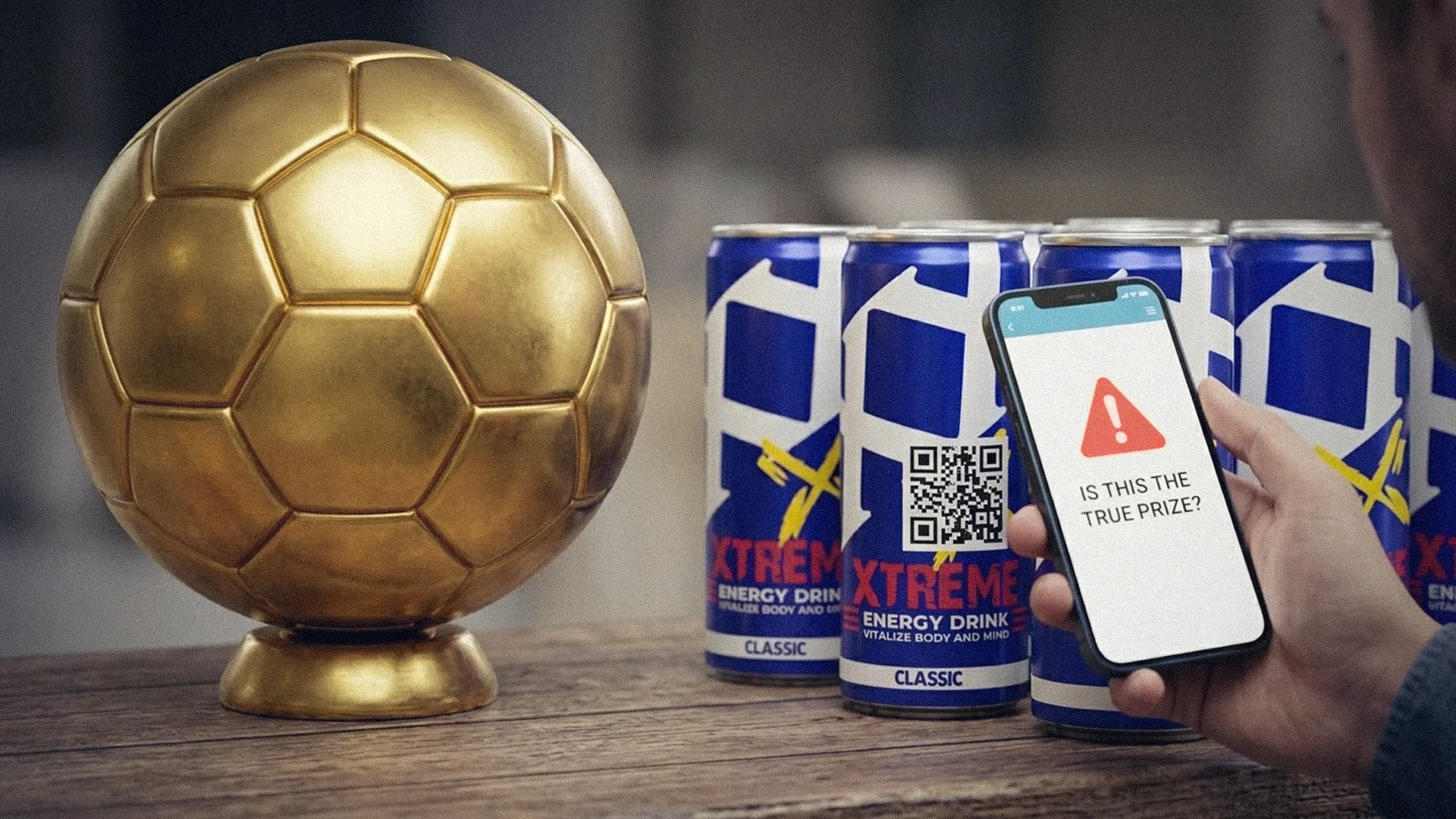
Consumers will no longer have to face the hassle of rushing to expensive jewelry shops or bullion traders in New Road to buy gold, because the precious metal has now started becoming available at local grocery shops in every alley. However, this gold cannot be bought directly by paying money at the grocery shop counter. Instead, if one buys the health-hazardous and addictive 'xTreme' energy drink lined up there and scans the QR code on it, three lucky winners among those who scan will receive a 'gold football' each as a prize. While a standard football played in the FIFA World Cup weighs between 410 to 450 grams, creating an undeniably solid gold football would undoubtedly bring its weight into kilograms, making the total weight for 3 winners definitely around 3 kg.
Capitalizing on the mega-atmosphere of the FIFA World Cup 2026, this promotional gimmick brought to the market by 'xTreme' energy drink, manufactured by Agro Thai Foods Pvt. Ltd., is a blatant mockery of consumer rights and business ethics. The company has announced the gifting of a 'gold ball' in large letters in its advertisement, but it has nowhere clearly disclosed how much it will weigh, whether it is truly solid gold, or just a gold-plated toy football meant to mislead consumers. Keeping consumers completely in the dark and tempting them with such an impractical and opaque prize is a serious violation of the business code of conduct and an act against consumer protection laws.

Interested in this ad?
Would you like to continue to the link or provide your information for more details?
Please provide your information
To continue, please fill in your details
Just as this unhealthy chemical drink dangerously 'spikes' blood sugar levels immediately upon entering the human body, this aggressive advertisement has similarly 'spiked' the level of illusion in the minds of innocent Nepali people. According to public health experts, this beverage is not a normal cold drink or a less harmful beverage. When people who are regularly taking medication for heart disease, diabetes, or other chronic illnesses consume such strong synthetic caffeine and highly sugary chemical drinks, there is a high risk of dangerous reactions between the medicine and its ingredients, which could even result in death—a fact completely suppressed by the flashy cover of the advertisement.
From a factual perspective, the suspicious flood of such opaque gift schemes worth millions and extremely misleading advertisements suddenly appearing in the Nepali market might not just be a commercial gimmick to deceive consumers. In a Nepali market with a weak economic condition and flimsy legal regulation, a company selling a low-value beverage suddenly advertising a prize carrying such an unnatural and massive financial liability raises serious financial suspicions. According to market analysts, there is a strong possibility that the unnatural graph of such suspicious corporate campaigns, which cross business boundaries, might be internally connected with a network of organized and high-profile illegal crimes such as high-level illicit financial activities, widespread tax evasion, or money laundering, into which the state's regulatory bodies must immediately initiate a high-level financial investigation.