Nepal's March 5 Elections: Supreme Court Verdicts, Interim Government, and Political Uncertainty Ahead
Narayan Manandhar
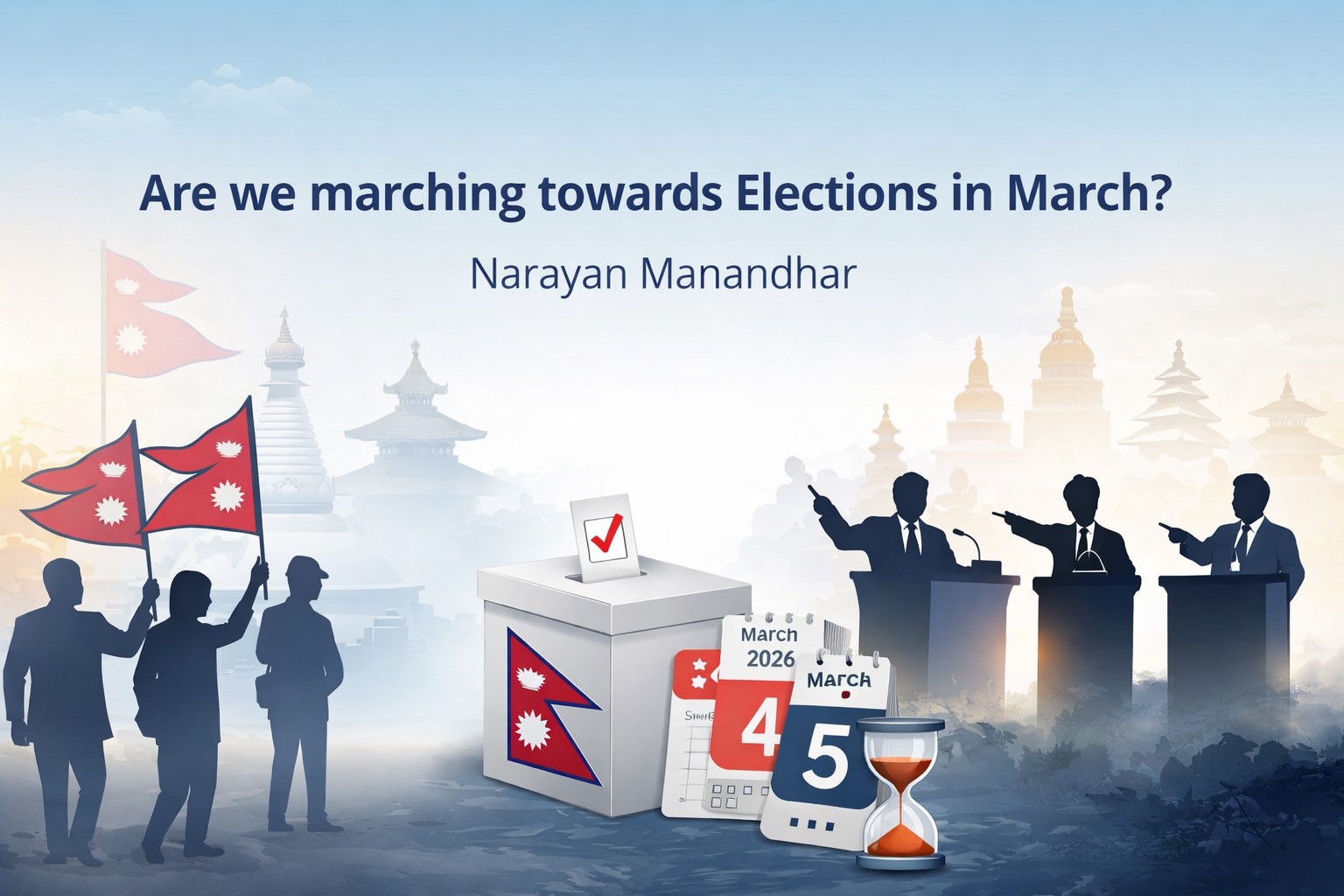
The answer to the above question may be both “yes” and “no”. However, this week we saw two eye-catching news items. First, after five years, the Supreme Court finally published its full verdict related to the first dissolution of the parliament by then-PM Oli in 2077 BS. This indicates that the Court is warming up to decide on dozens of writ petitions filed against the unconstitutional dissolution of the parliament and the appointment of former CJ Mrs. Sushila Karki as the head of an Interim Government.
Second, PM Mrs. Karki has shown the exit door to her Cabinet members wishing to contest elections or join political parties. By the time of this writing, one of her powerful ministers has resigned. She assumes her government to be a non-partisan, civilian government. This, again, signals the government’s determination to hold elections on time.
Meanwhile, our netas are busy visiting the Southern neighbor. The relaxation on deposed PM Oli’s movement seems to have softened his anti-government and anti-election stance. He has not lost hope with the court.
There are also overnight, makeshift political splits, alliances, and configurations taking place, triggered primarily by the upcoming elections rather than ideological fermentation and distillation. The political parties have submitted their closed lists of PR candidates and are preparing themselves for voting on the 5th of March. Some zealots are so cocksure of their victory that they have already declared a would-be PM and directed a would-be Finance Minister to start drafting the budget for the coming fiscal year! The problem with him is: he still thinks he is running a TV show.
For the benefit of readers, I have summarized here the views and counter-views on the upcoming 5th March elections:
1. Those favoring elections on time:
A. Elections are the only way to resolve our differences in a democratic manner. Democratic parties should not fear going to the polls.
B. The country will have to face dire consequences if we don’t have elections on time.
C. The Interim Government has a single mandate to hold elections, and Madam Karki is desperate to hand over power to an elected government ASAP.
D. She has received all the necessary support from her Gen-Z fans, new and old political parties, the bureaucracy, and the security forces. Moreover, she, too, is committed to creating a conducive environment. That must be the reason for signing a 10-point agreement with Gen-Z, negotiating with pro-monarchists, and breaking hunger strikes.
2. Those not favoring elections:
A. Two big political parties still hold reservations on holding elections as scheduled.
B. The writ petitions are pending at the Supreme Court. This is like the Sword of Damocles hanging over the head of the Karki government.
C. There is a saying, “It is stupidity to expect a different result doing the same thing.” Given the mixed electoral system and the country’s demographic profile, it will be stupidity to expect a different outcome. It is for sure that we will continue to have coalition governments without a major overhaul of our electoral system.
D. Some groups are seeking to disturb elections. There are people who continue to assume that the upcoming elections are forced onto them, that there is betrayal in the Gen-Z movement, and that it has been infiltrated and hijacked.
E. Given the weather conditions, we may have to face technical problems in mountain areas.
3. The Spoilers
Equally, there are also spoilers possibly seeking to disturb the elections. These include:
A. Demanding voting rights for Nepalese working abroad.
B. Demanding changes in the voting system; these include introducing a full PR system, a directly elected chief executive, etc.
C. The demands for good governance and controlling corruption cannot be fulfilled overnight.
D. Calls for postponing elections from March to April-May.
E. Ongoing quibbling within the Nepali Congress Party.
F. We are simply having early elections, two years ahead of the elections scheduled for 2084.
4. Are elections a panacea to our political problems?
It is one thing to say we should not be scared of elections; elections are fundamental to democratic societies. But it is a different thing to say that all of our ills will be solved, or if not, then resolved by elections.
The quality of elections is far more important than simply having a round of elections. During the royal takeover, former King Gyanendra, too, had his local-level elections. The quality of elections rests on their legitimacy. There is no meaning in holding elections for the sake of holding elections. The scariest part of the upcoming elections is the possibility of violence, something akin to what the country observed on 8-9 September. The intensity of political polarization—between new and old political parties, between youngsters and the elderly, and between parties supported by the Nepali diaspora (external) and people inside Nepal (internal)—has led to an “us vs. them” situation, leading to a win-lose scenario. There are more chances of violence when you end up with a win-lose situation. Can we make this election a win-win situation? I leave this matter with the readers.
Narayan Manandhar
![From Kathmandu to the World: How Excel Students Are Winning Big [Admission Open]](https://www.nepalaaja.com/img/70194/medium/excel-college-info-eng-nep-2342.jpg)