As KP Sharma Oli Secures UML Leadership Again, Critics Question Democratic Process
By Madhav Guragain
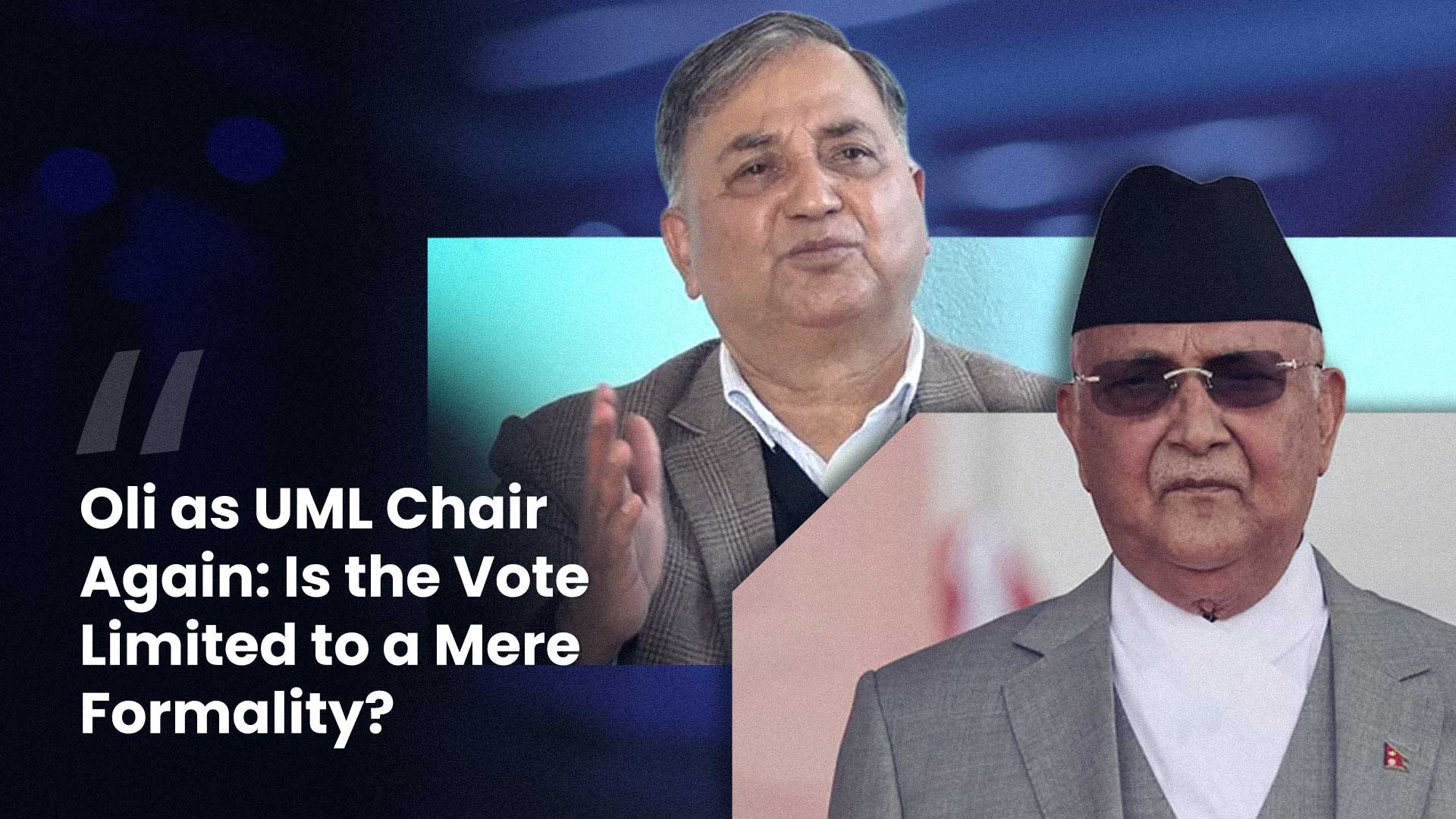
Standing in clear opposition to the political consciousness shaped by the Gen-Z movement, Nepal’s Communist Party (UML) is now actively mobilising anti-change sentiment to reassert itself as a decisive force in power politics. At the centre of this strategy stands party chair KP Sharma Oli. The recently concluded UML general convention—and the near certainty of Oli’s re-election as party chair—underscores this direction.

The reality, however, is that compared to Oli’s previous administration, the current government has shown comparatively better performance in governance, at least in the public perception. Had Oli’s government demonstrated similar sensitivity and administrative engagement during its tenure, the Gen-Z uprising might not have erupted onto the streets with such intensity. Political movements of this nature are products of accumulated discontent, and responsibility for that discontent cannot be entirely detached from the former ruling establishment.
In terms of development and service delivery, Kulman Ghising’s working style has been notably effective—often described metaphorically as sharper than “Katappa’s sword.” Other ministers may also be delivering within their respective domains. At the very least, the current leadership has begun to project seriousness in listening to public concerns, communicating transparently, and responding to crises. Prime Minister Sushila Karki and her team appear more attentive to governance, which should be acknowledged as a positive signal.
Turning to UML’s internal politics, the AI-generated image unveiled during the convention—and the debate it sparked—is not merely symbolic. A widespread perception has taken hold, both within and outside the party, that the outcome of the chairperson election was decided well before any votes were cast. In a tone of satire, it is now said that regardless of who votes for whom, the “algorithm” inside the voting machine is programmed to ensure Oli’s victory. There is even talk that this entire arrangement was orchestrated by Asgar Ali.
While the convention’s inaugural session has concluded and the election of office-bearers is set to proceed, the very notion that results are “pre-determined” raises serious concerns about the integrity of democratic processes. Speculation that voting machines and even social media algorithms are being managed by Oli’s loyalists further deepens doubts about internal party democracy.
In this context, ironic remarks have also surfaced suggesting that whether Ishwar Pokharel contests the election or not, the outcome will still mirror that of Bhim Rawal. Yet, Pokharel’s decision to declare candidacy for the party leadership should not be dismissed lightly. In institutional politics, the mere act of contestation is itself significant.
Ultimately, the satire circulating today captures UML’s internal condition with biting clarity: it is no longer party cadres who cast votes for Oli—artificial intelligence does. While framed as humour, this narrative raises serious questions about power concentration, decision-making structures, and the actual state of democratic practice within the party.

![From Kathmandu to the World: How Excel Students Are Winning Big [Admission Open]](https://www.nepalaaja.com/img/70194/medium/excel-college-info-eng-nep-2342.jpg)