Nepal’s Constitutional Crisis: March 5 Elections vs. Parliament Reinstatement
Elections vs. Reinstatement
By: Narayan Manandhar
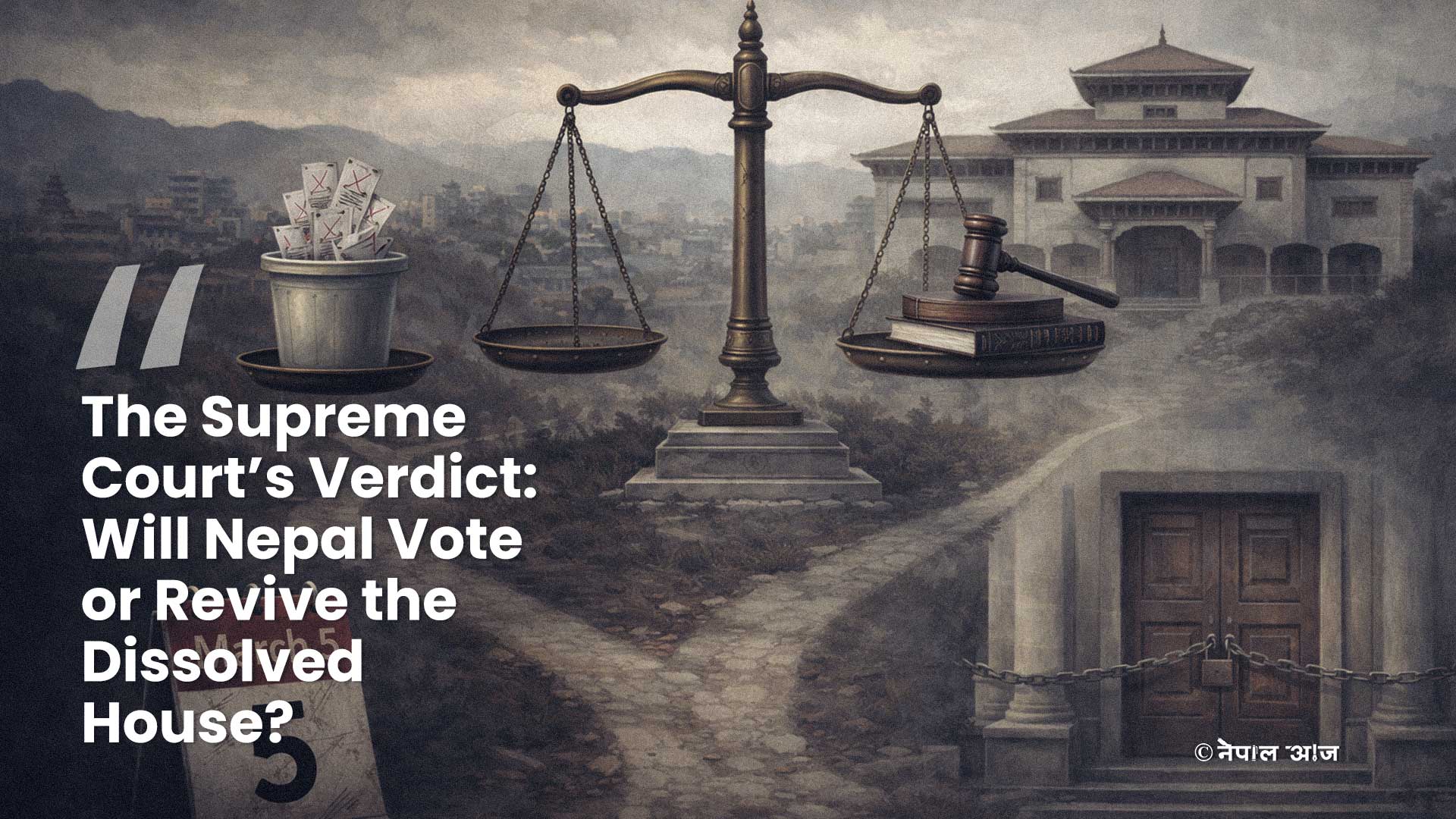
Following the Gen-Z Movement, the country's politics has crystallized around two central issues: holding the parliamentary elections scheduled for March 5, or reinstating the parliament dissolved following the formation of the Interim Government led by former Chief Justice Sushila Karki. Over the last three months, the political pendulum has been swinging between these two poles.
Paradoxically, these are not mutually exclusive, "either-or" propositions. The ultimate purpose of holding elections is to secure a fresh mandate for a new parliament. Conversely, advocates for reinstatement argue that reviving the House—albeit briefly—would pave the way for early elections after addressing the demands of the Gen-Z movement, including constitutional reforms. Both camps share a common goal: to put the derailed constitutional process back on track.
There is a near consensus that if elections cannot be held, the dissolved parliament must be automatically reinstated. While conspiracy theorists claim the court might reinstate the House solely to thwart elections and create political havoc, the reverse is also possible: elections may fail to materialize, necessitating reinstatement. Regardless, the situation remains extremely fluid. The million-dollar question remains: Will elections actually solve our political problems?
Parties and their Stances
Among the three major mainstream parties, the CPN-UML—currently the largest in terms of popularity—is squarely in favor of reinstating parliament, arguing that the dissolution was unconstitutional. This does not necessarily mean they fear elections. While they have filed a writ petition seeking reinstatement and publicly argue that security conditions are not conducive for polls, they are internally preparing for the vote. Their primary motivation for the legal challenge is to test the Supreme Court against its own precedents. The Court has previously quashed then-PM KP Oli’s decision to dissolve parliament twice, categorically ruling that the House cannot be dissolved before its five-year tenure is complete if alternatives to form a government exist.
The Maoist Centre, led by Pushpa Kamal Dahal—now transformed into the Nepal Communist Party following unification with a dozen smaller parties—is a distant third but strongly favors holding elections on time. For them, there are no "ifs" or "buts." They have warned of dire consequences if the scheduled polls are delayed, though media reports suggest they would not object if the Court overrules the dissolution.
The Nepali Congress, the second-largest party, occupies a middle ground. One faction has petitioned the court for reinstatement, while another favors elections. Some voices within the party even seek a temporary postponement. The party is currently mired in internal turmoil regarding whether to hold its general assembly—expected to elect a new leader—before or after the national elections.
Save for a few exceptions, smaller and newer parties favor holding elections. It is natural for them to take this stand, as they have little to lose.
As March 5 approaches, the intensity of political polarization and realignment is on the rise. Meetings between the political trio—Deuba, Oli, and Dahal—first with the President and then with the Prime Minister, point toward the possibility of elections proceeding. The strong reservations held by CPN-UML and Chair Oli against the Interim Government and the upcoming polls are gradually softening, though they continue to cite a lack of a "conducive environment." The ultimate test will be the relaxation of restrictions on Oli’s movement, the release of his seized passport, and the investigation commission seeking testimony regarding the incidents of September 8-9.
The Ball is in the Court
Metaphorically, the election ball is now in the Supreme Court. Time is running out. There are three possibilities: the Court may reinstate parliament; it may quash the writ petitions against the Interim Government and the dissolution; or it may delay its verdict until the elections take place. Sensing the third possibility, a forum of former Chief Justices recently issued a statement urging the Court to deliver its verdict before the polls. The upcoming elections must be subjected to judicial scrutiny. Mr. Oli, too, has expressed displeasure over the pace of court procedures.
The Spoilers
There are many potential spoilers. Although PM Sushila Karki publicly claims her main agenda is to hold elections and hand over power to an elected government, her actions speak louder than words. Her Cabinet appears more engaged in daily administrative work than in serious election preparations. While she claims to lead a non-partisan, civilian government, her active involvement in forming a new party and political alliances violates the very concept of conflict of interest. Her formation of a dialogue team was too little, too late. Furthermore, she has been unable to shed her extreme distaste for mainstream parties and has failed to win the trust of the fractious Gen-Z groups that literally put her in power.
The biggest spoilers, however, may be the Gen-Z groups themselves. Some factions have vowed to disrupt the elections. They are so divided that no one is entirely sure of their collective demands. Their insistence on instant good governance and the eradication of corruption is impossible to achieve overnight; there are no quick fixes to systemic issues. Moreover, their demand for a purely punitive approach to controlling corruption is not only naive but dangerous.
The extreme political polarization taking place does not bode well for the country. While such polarization may be a strategic move to consolidate votes, it essentially categorizes political actors into adversarial "us vs. them" camps, leading to entrenched conflict. One political party has even gone so far as to name a prospective Prime Minister and Cabinet members before a single vote is cast. In such tense times, perhaps humor is the only way to release political tension.


![From Kathmandu to the World: How Excel Students Are Winning Big [Admission Open]](https://www.nepalaaja.com/img/70194/medium/excel-college-info-eng-nep-2342.jpg)