Post-Maduro Chaos: The Dangerous Legitimacy Trap Facing U.S. Operations in Venezuela Today
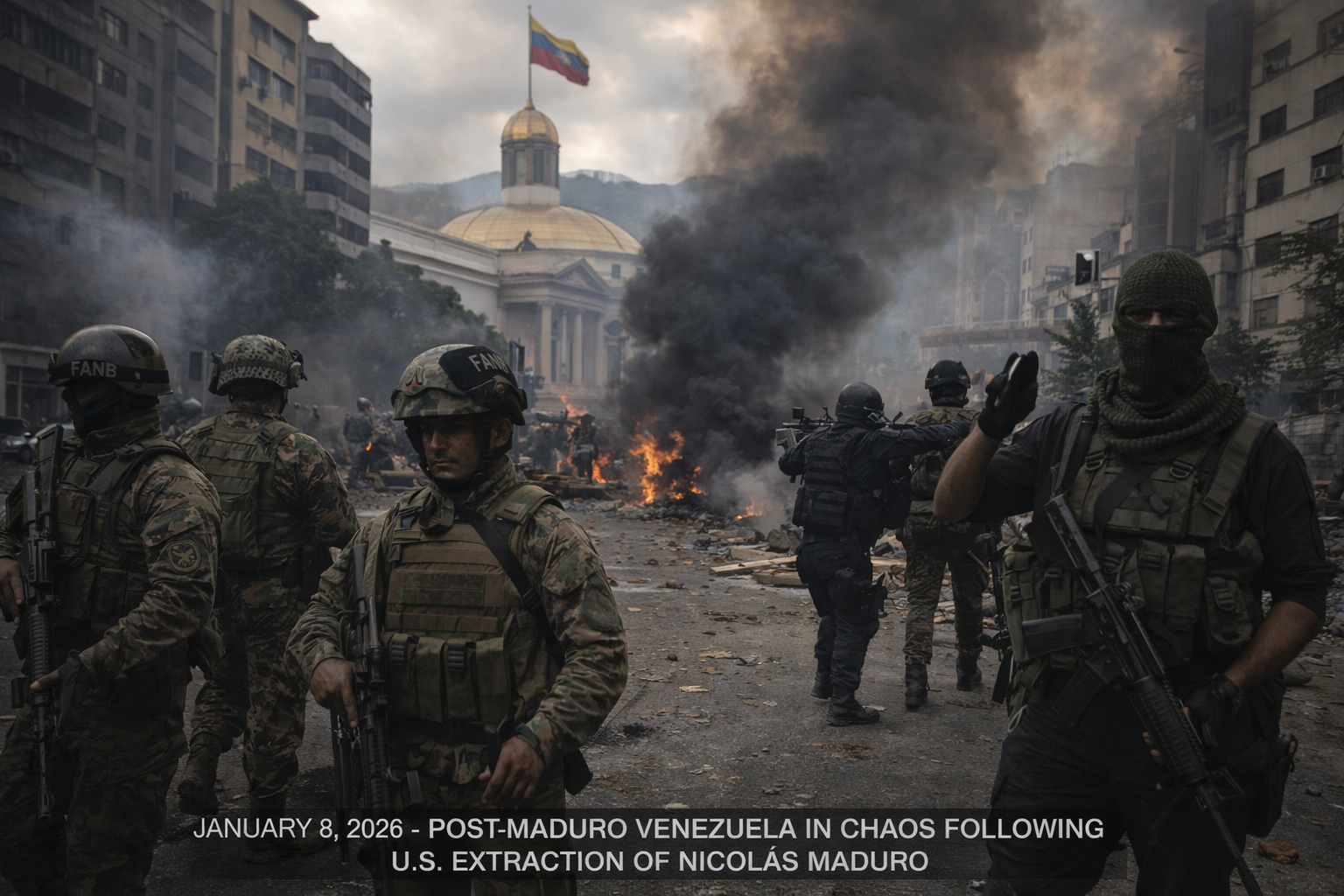
The predawn extraction of Nicolás Maduro by U.S. forces on January 3, 2026—codenamed Operation Absolute Resolve—was heralded in Washington as the decisive stroke that would sever the head of a "criminal enterprise" and restore Venezuelan democracy.1 However, in the days following the operation, the jubilant narrative of a surgical decapitation has collided with the obdurate reality of the Venezuelan state. Far from a clean break, the removal of the executive has plunged the nation into a perilous administrative gray zone, revealing a profound miscalculation in U.S. strategy: the conflation of a dictator with the state apparatus he controlled. As the USS Iwo Jima steams toward New York, the vacuum left behind is being rapidly filled not by a transitional democratic authority, but by a fragmented, highly militarized "Deep State" that remains operational, armed, and deeply hostile to the prospect of American direct rule.
The Promise: A Kinetic Revival of the Monroe Doctrine
The architect of this intervention, the Trump administration, framed the operation as the ultimate expression of a revived, kinetic Monroe Doctrine.2 Moving beyond the "maximum pressure" sanctions of previous years, the White House embraced a policy of "sovereign forfeiture"—the legal theory that a regime deemed a "narco-terrorist organization" loses its protections under international law. The official rationale was seductive in its simplicity: remove the keystone (Maduro), and the arch of Chavismo would crumble, allowing the U.S. to temporarily "run" the country’s critical infrastructure and oil sector until elections could be organized.3 This vision was predicated on the assumption that the Venezuelan armed forces (FANB) were loyal only to the man, not the system, and would welcome U.S. oversight as a stabilizing force. Planners envisioned a rapid transition where American technocrats, partnered with exiled opposition figures and energy majors like Chevron and ExxonMobil, would immediately secure the Orinoco Belt, restart production, and use oil revenues to fund a Marshall Plan for national reconstruction.
The Breakdown: The "De-Baathification" Trap
This optimism has disintegrated upon contact with the institutional reality on the ground. The extraction of Maduro did not trigger the expected mass defections or institutional collapse. Instead, it activated the regime's survival protocols. The Supreme Tribunal of Justice (TSJ), stacked with loyalists, immediately declared the "administrative continuity" of the state, swearing in Vice President Delcy Rodríguez as the constitutional successor. This move created a dual-legitimacy crisis: Washington claims executive authority based on "conquest and custody," while Caracas retains bureaucratic control based on constitutional succession.
Crucially, the U.S. appears to be sleepwalking into a "legitimacy trap" reminiscent of the De-Baathification of Iraq in 2003. By declaring an intent to "run" Venezuela, the U.S. effectively delegitimized the entire public sector workforce—millions of soldiers, police officers, judges, and civil servants whose livelihoods are tied to the party-state. Rather than dissolving, these structures have hardened. The FANB high command, deeply embedded in the country’s lucrative mining and logistics sectors, views the U.S. announcement not as liberation but as an existential threat to their economic fiefdoms. Reports from the interior indicate that regional military zones (REDI) are operating semi-autonomously, effectively ignoring orders from both the new "Acting President" Rodríguez and U.S. directives, establishing local warlord-style governance to protect illicit revenue streams.
The Reality: An Interregnum of Chaos
The economic dimension of the intervention faces a similar paradox. The promise of "getting the oil flowing" is crashing against the physical and legal ruins of the industry. While the U.S. Treasury has lifted sanctions to allow American operational control, the physical infrastructure is too degraded for an immediate restart. Pipelines are rusted, refineries are cannibalized, and the skilled labor force has long since emigrated. Furthermore, the legal ownership of Venezuela’s assets is now a geopolitical minefield. Russia and China, major creditors who hold liens on Venezuelan oil shipments, have denounced the U.S. move as an act of "piracy" and "armed aggression." Beijing has implicitly threatened to activate cross-default clauses that could freeze Venezuelan assets globally, complicating any U.S. effort to monetize oil exports for reconstruction.
Socially, the population is trapped in a terrified limbo. The "liberation" has not brought food or medicine, but rather a securitized lockdown. In the barrios of Caracas, the paramilitary colectivos—armed groups that functioned as the regime’s enforcers—have mobilized to defend their territories against perceived "imperialist invaders." Clashes between these irregulars and U.S. special operations teams attempting to secure key facilities have already been reported, signaling the start of a potential asymmetric insurgency.
The United States now faces a stark choice. It can attempt to govern Venezuela by decree from 2,000 miles away, relying on a "shadow government" of exiles that lacks local buy-in, likely leading to a prolonged and bloody occupation. Or, it can attempt to force a negotiation with the very "narco-terrorist" generals it swore to defeat, trading amnesty for a semblance of order. As the initial shock of the extraction fades, the stark reality settles in: Operation Absolute Resolve has successfully captured a prisoner, but it has potentially lost the country. The region now sits in a dangerous interregnum, where the old order is decapitated but alive, and the new order is an imposition that no one on the ground is willing to accept.
Donald Trump


![From Kathmandu to the World: How Excel Students Are Winning Big [Admission Open]](https://www.nepalaaja.com/img/70194/medium/excel-college-info-eng-nep-2342.jpg)