Record trade surplus hides the story of imbalance in Chinese economy
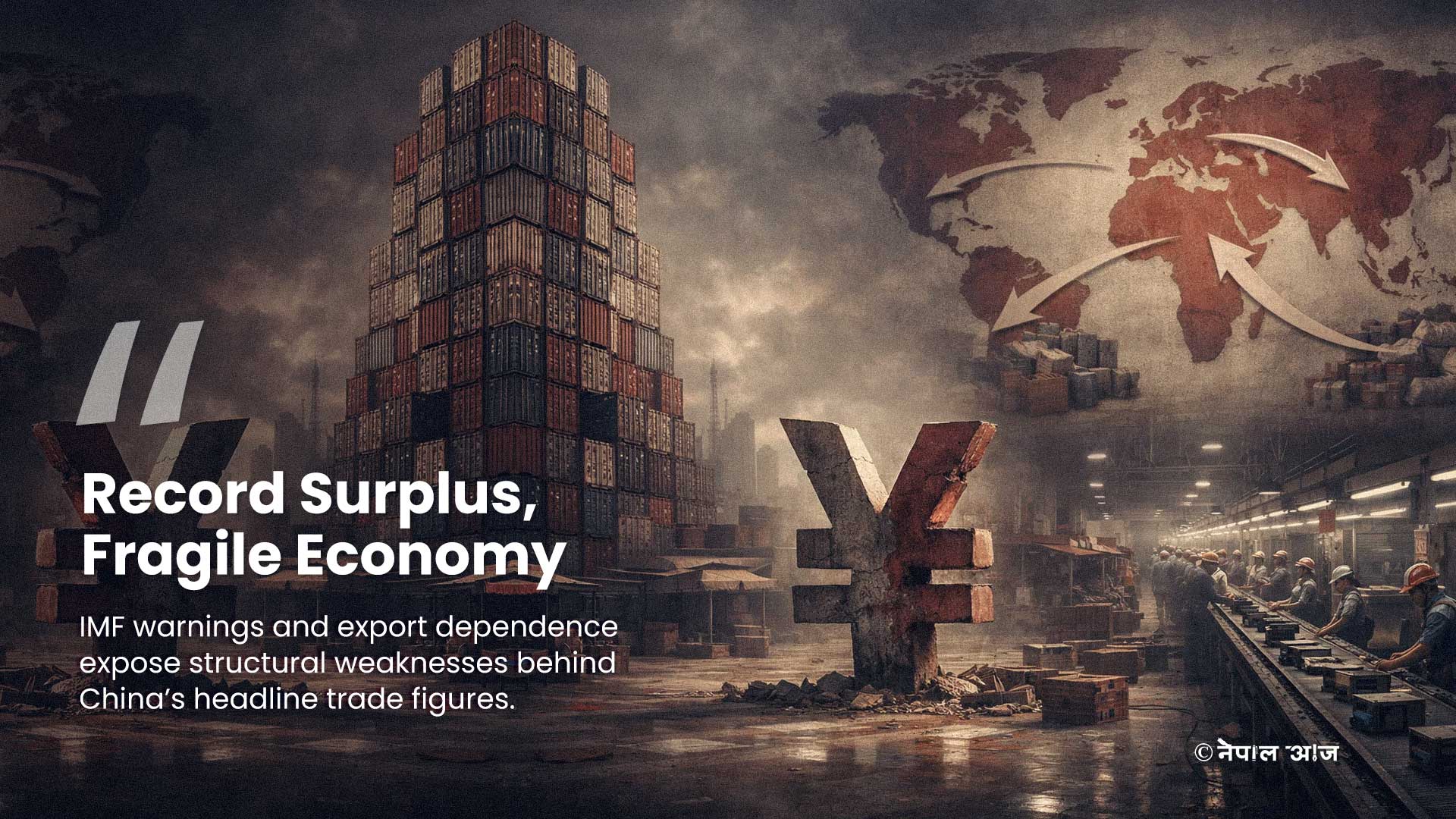
Mandarins in Beijing may be feeling smug that China has amassed a record trade surplus of $1 trillion, thus turning half of the world into captive markets for cheap Chinese products. But this very figure hides the uncomfortable story of a serious imbalance facing the Chinese economy: weak domestic demand, a weakening of the Chinese currency and a slowing down of the rate of growth.
The International Monetary Fund has warned China against economic imbalances. A country of 1.4 billion people is too big to rely only on exports to ensure a high growth rate. “China is too big to rely on exports as a source of growth. It has a big domestic market,” IMF Managing Director Kristalina Georgieva has said. The continued dependence of Beijing on export-led growth may accentuate global tensions. It may provoke moves by other countries to curb imports from China, like the hike in tariff by the US on Chinese imports.
Comprehensive policies are needed to encourage the Chinese people to spend more, the IMF has said. Domestic demand in China has weakened as consumers have cut back on spending since the pandemic that had led to large-scale job- and income-loss. The slump in the property market has also hit family wealth hard. Common people in China are now wary of spending large amounts.
The large trade surplus that China is enjoying is also an indication of the weakening of the Chinese economy. The Chinese people are not spending enough on imported goods because of financial constraints, leading to a fall in imports to China and a rise in trade surplus. The slowing down of the rate of GDP growth to five percent has also reduced the need for imported inputs of production.
In November 2025, Chinese exports increased by 5.9 percent while imports increased by only 1.9 percent; something difficult to explain for a normal healthy economy. Usually, countries which depend largely on the domestic market for growth go for import substitution while export-oriented economies also have to depend on imported inputs to produce items meeting the global standards.
The impression that this $1 trillion trade surplus portrays China as a manufacturing superpower is based on wrong premises. The additional tariff imposed by the US on imports from China has reduced Chinese exports to a high value market like the US. China has tried to resist the fall in the exports to the US by increasing exports to the economically weaker markets of Africa, Latin America and Southeast Asia.
With the overall tariff rate on China imposed by President Donald Trump now being 47 percent, Chinese exports to the US fell by 29 percent in November 2025 on a year-on-year basis. In the area of textiles and apparels, for instance, imports by the US from China have fallen by 27 percent. Other Asian countries, notably Vietnam, India and Bangladesh, have managed to increase their exports to the lucrative American market.
In this period, China has recorded a 26 percent increase in exports to Africa, 14 percent to Southeast Asia and 7.1 percent to Latin America. Chinese exports to the European Union, too, have surged by 15 percent from a year earlier, but the European Union Chamber of Commerce in China has already warned Beijing about its substantial trade deficits with China.
Unfortunately for Beijing, markets in Africa, Latin America and Southeast Asia cannot offer Chinese products the same price that the American buyers can afford. A study by the United Nations Conference on Trade and Development in 2019 during the tariff war with China in US President Donald Trump’s first term found that “Chinese exporters may have started to bear part of the costs for China’s export losses in the United States because of tariff and the resultant trade diversion in the form of lower export prices.”
In the second phase of the tariff war in May last, Chinese export houses were forced to sell online at bargain prices products ranging from footwear to home appliances and blankets which used to sell in the US at fancy prices. For instance, the cost of one tonne of Chinese blanket in the US has been calculated at $ 5,300 while that in Africa it varies between $1,800 and $3,500 depending on quality.
Evidently, to meet the requirements of these less affluent markets, manufacturers in China are cutting back on cost; and consequently also on quality. China is thus emerging as the hub of low-cost products of questionable standards. A vast repository of cheap labour has helped China achieve this rather dubious distinction.
Observers believe that at the heart of the remarkable achievement of a $1 trillion trade surplus are ultra-low prices made possible through practices such as indifferent product quality, dumping, aggressive marketing and deceptive trade tactics. Clearly, the benefits of this trade surplus do not percolate to Chinese labourers. In the textile sector, for instance, the average monthly salary of a worker in China in 2023 was calculated at $826 while in the US the average monthly salary of a worker in the textile sector was calculated at $2,858.
The dumping of cheap Chinese products in Africa is having a devastating effect on the industries in the African countries which are being slowly forced out of trade. Findings of the Southern Africa Labour Department and Research Unit from a database of 44 manufacturing industries over the last decade show that local industries in Southern Africa are under pressure because of cheap Chinese imports. This has resulted in their slow growth of output, loss of profits and decline in employment. Products significantly affected by Chinese imports are textiles and clothing, footwear and leather, electrical and electronic products and machinery.
China has resorted to increasing exports in low value markets to sustain an annual GDP growth rate of five percent when the domestic market is sluggish. In November last, retail sales increased by only 1.3 percent, the lowest since 2022. The growth in industrial production slowed to a 15-month-low of 4.8 percent. The property sector performed the worst in decades, with investments in property plunging nearly 16 percent. Car sales went down by 8.5 percent and home appliance sales by 19 percent. China’s National Bureau of Statistics has admitted that domestic demand is insufficient.
The main reason for the sluggish domestic demand is the falling prices of real estates in which nearly 70 percent of the household wealth in China has been estimated to be tied up. This fall has shaken the confidence of the common people as their wealth is shrinking.
In the days of the export boom in China under the Deng Xiaoping regime, the exchange rate was 8.38 Chinese yuan per US dollar; leading to accusations of artificial devaluation. In 2005, there was a revaluation of Chinese currency. In 2010, for instance, the dollar to yuan exchange rate was on average about 6.5. But now for about a decade the value of yuan is falling again; with the prevailing exchange rate being about 7. It is artificial method of increasing exports when the domestic market is sluggish.
The record trade surplus thus hides the story of imbalances in the Chinese economy.
China tariffs tradeSurplus


![From Kathmandu to the World: How Excel Students Are Winning Big [Admission Open]](https://www.nepalaaja.com/img/70194/medium/excel-college-info-eng-nep-2342.jpg)