By Tsering Passang, Founder-Chair, Global Alliance for Tibet & Persecuted Minorities
March 10 is not merely an anniversary for Tibetans. It is a day of national remembrance, political resolve, and global solidarity. As geopolitics shifts and China’s global influence deepens, this date has acquired renewed relevance – not only for Tibetans in exile, but also for democracies grappling with Beijing’s growing assertiveness and transnational repression.
From “Peaceful Liberation” to Military Invasion
After the Chinese Communist Party established the People’s Republic of China in 1949, Chairman Mao declared the “peaceful liberation” of Tibet from foreign imperialists. Soon afterwards, the People’s Liberation Army entered Tibetan territory from the eastern frontiers and never left the peaceful Buddhist nation, which has rich and unexploited natural resources, and also a geo-strategic location. For Tibetans, this marked the beginning of modern China’s invasion, which subsequently saw the death of over 1.2 million Tibetans and the destruction of Tibet’s great learning centres – over 6000 Buddhist monasteries and nunneries.
On 23 May 1951, Tibetan representatives in Lhasa signed the so-called “Seventeen-Point Agreement” with Beijing. Tibetans have consistently maintained that the agreement was signed under duress. Lukhangwa, the Tibetan Prime Minister, made clear in 1952 that the Tibetan people did not accept it.
His Holiness the 14th Dalai Lama, then still a teenager, with very little option, chose to work with the Chinese authorities in an effort to prevent further destruction. In his memoir My Land and My People, he wrote that he did so to “save my people and country from total destruction.” For eight years, he attempted to honour the agreement.
In 1954, the Dalai Lama travelled to Beijing, where he met Mao Tsetung and Premier Zhou Enlai, both of whom assured him of Tibet’s future autonomy. In 1956, during a visit to India for the 2500th Buddha Jayanti celebrations, he discussed Tibet’s deteriorating situation with Indian Prime Minister Jawaharlal Nehru. Although he considered seeking asylum, he was advised to return to Lhasa and pursue dialogue.
10 March 1959: The Uprising
By early 1959, tensions in Lhasa had reached breaking point. Around 20,000 Chinese troops were stationed in the capital, while fighting in eastern Tibet had already displaced thousands.
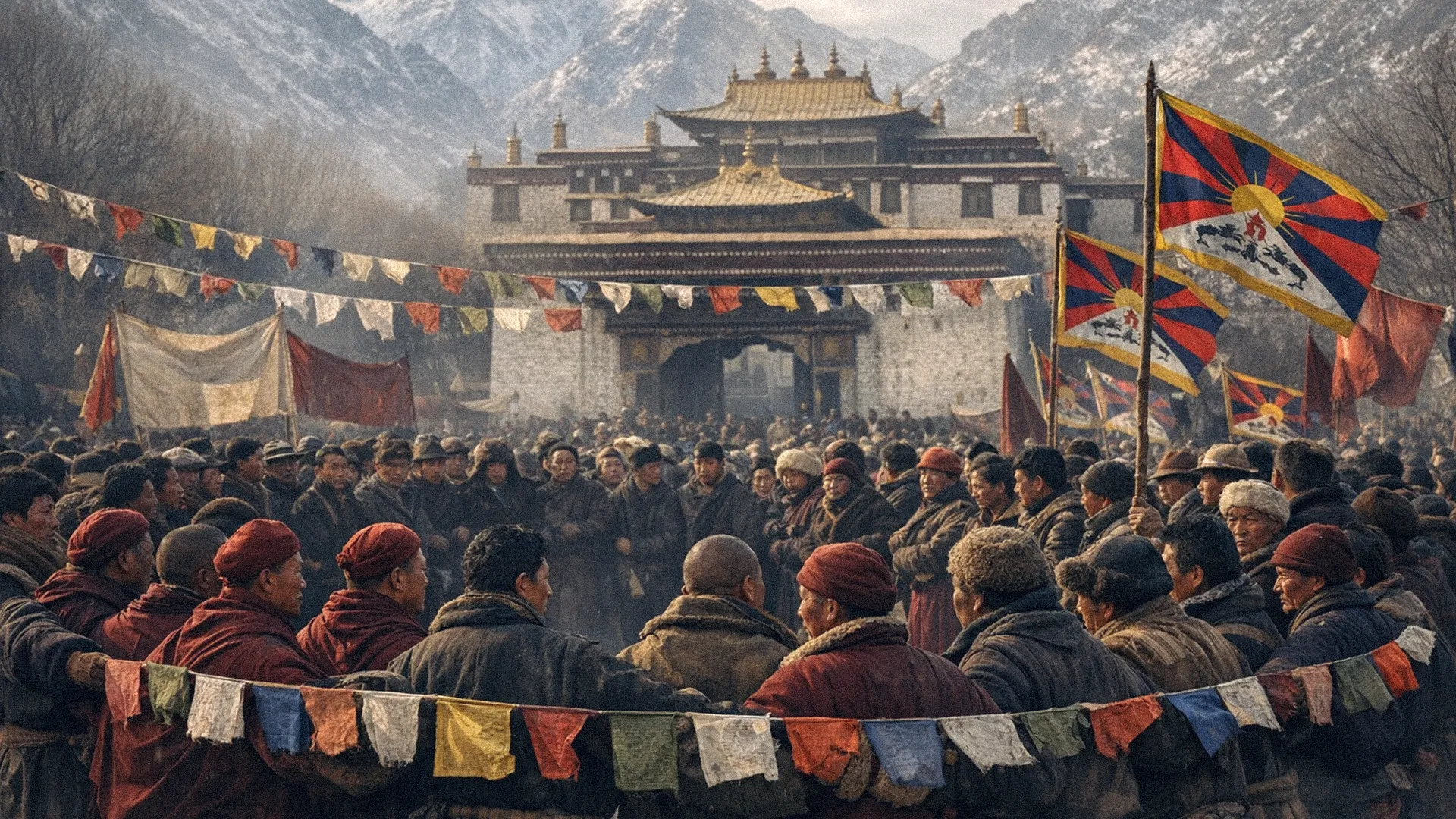
On 10 March 1959, amid fears that the Dalai Lama would be abducted after being invited to a Chinese military function without bodyguards, more than 30,000 Tibetans surrounded the Norbulingka Palace to protect him. The situation escalated rapidly. Days later, artillery shells landed near the Dalai Lama’s summer palace.
On the night of 17 March, disguised as a soldier, the young Dalai Lama escaped Lhasa. After a perilous journey, he reached India on 31 March 1959. Nearly 80,000 Tibetans followed him into exile in India, while many others fled to Nepal and Bhutan.
Democracy in Exile
In Dharamsala, northern India, the Tibetan leadership re-established itself as the Central Tibetan Administration (CTA). Over the decades, the Dalai Lama gradually introduced democratic reforms. In 2011, he formally relinquished political authority, transferring leadership to a directly elected Sikyong (President), marking the end of a 400-year-old tradition of combined spiritual and temporal leadership.
Today, Tibetans in exile elect both their Sikyong and their Chithues (Members of the Tibetan Parliament-in-Exile), reflecting a maturing democratic culture. These elections are not symbolic; they embody a deep commitment to democratic governance – standing in stark contrast to the authoritarian system imposed inside Tibet.
The exile administration has built schools, monasteries, healthcare centres, and cultural institutions across India, Nepal and Bhutan, preserving Tibetan identity under extraordinarily difficult conditions. Yet the diaspora faces mounting challenges: funding constraints, generational transition, questions of identity preservation, and increasing pressure stemming from Chinese diplomatic and economic leverage in host countries.
A Changing Geopolitical Landscape
The Tibet issue now unfolds within a dramatically altered geopolitical environment. China is no longer the isolated power of the 1950s; it is a global superpower with vast economic reach. Through trade, infrastructure projects, and political influence, Beijing shapes international responses to Tibet.

Interested in this ad?
Would you like to continue to the link or provide your information for more details?
Please provide your information
To continue, please fill in your details
At the same time, concerns over human rights in Tibet intersect with broader global anxieties about Xinjiang (East Turkestan), Hong Kong, and Taiwan. The Chinese government’s insistence on its “One-China” Principle leaves no room for alternative identities or meaningful self-determination within territories it controls.
More troubling still is the rise of transnational repression. Tibetan activists in democratic countries report surveillance, intimidation, and pressure exerted on family members back in Tibet. This export of authoritarian control beyond China’s borders has become an increasingly visible feature of Beijing’s global posture.
Thus, March 10 has evolved from a commemoration of past tragedy into a platform to highlight ongoing repression and defend democratic values worldwide.
Annual Commemoration and Global Action
Every year on March 10, Tibetans across India, Nepal, Europe, North America, and Australasia hold prayer services, public gatherings, and political demonstrations. The Sikyong and the Speaker of the Tibetan Parliament-in-Exile issue official statements reviewing conditions inside Tibet and reaffirming the Tibetan people’s aspirations.
Grassroots organisations such as the Tibetan Youth Congress advocate for Rangzen – full independence – and organise protests outside Chinese embassies and at international institutions - calling for justice in Tibet.
In recent years, activism has adapted to global realities. Campaigns such as “Repeal One-China Policy” seek to challenge the diplomatic orthodoxy that sidelines Tibet. Prominent Tibetan activist-writer Tenzin Tsundue has mobilised supporters through long-distance marches and grassroots advocacy, symbolising resilience and visibility amid shrinking civic space.
In cities such as London, New York, Paris, Toronto, and Delhi, Tibetans and their supporters march to Chinese embassies, often stopping at symbolic sites – including Indian diplomatic missions – to underscore the regional dimension of the Tibet question. Acts of solidarity, including more than 300 towns and cities worldwide raising the Tibetan flag, send important moral signals even when governments remain cautious.
Why March 10 Still Matters
For Tibetans inside Tibet, open commemoration is impossible. Daily life is shaped by pervasive surveillance, restrictions on religious practice, limits on Tibetan-language education, and severe constraints on political expression. Information from within Tibet is tightly controlled, making the voice of the diaspora all the more vital.
For younger Tibetans born in exile, March 10 represents both inheritance and responsibility – a reminder that their democratic freedoms were hard-won and must be safeguarded. In Nepal, expressions related to the Tibetan people’s political and human rights aspirations have also been banned, and under China’s growing influence, the country has increasingly been described by some observers as a “second Tibet.”
For the international community, the day offers an opportunity to reassess policies shaped primarily by economic considerations. As China’s global influence expands, so too does the need for principled engagement rooted in human rights and the rule of law.
Nearly seven decades after the 1959 uprising, Tibetans remain stateless yet steadfast. Through the democratic election of Sikyong and Chithues, through peaceful protest, and through unwavering commitment to non-violence inspired by the Dalai Lama’s leadership, they continue to assert their identity and aspirations.
March 10 keeps the flame alive – not only for Tibet’s past, but for its future in a rapidly changing world.

Tsering Passang is a London-based Tibetan blogger and the founder–chair of the Global Alliance for Tibet & Persecuted Minorities. A long-standing Tibetan human rights advocate, he works internationally to advance justice, freedom, and peaceful solutions for Tibetans and other persecuted communities living under authoritarian rule. His writing and advocacy works can be found at www.Tsamtruk.com.