

By Munir Mengal
A Saudi commentator's unusually direct account of Riyadh's role in Sudan has cast fresh light on a reported $1.5 billion Pakistani arms deal — and drawn an appeal to the United Nations from Baloch organisations who warn the weapons could fuel both Sudan's war and Pakistan's campaigns at home.
A rare public admission from Riyadh's camp
Saudi influencer, op-ed writer and political analyst Mohammad Al-Sultan has publicly credited Saudi Arabia and Pakistan with helping the Sudanese Army withstand the Rapid Support Forces (RSF), offering an unusually direct account of Saudi Arabia's alleged role in a conflict that has torn Sudan apart since April 2023.
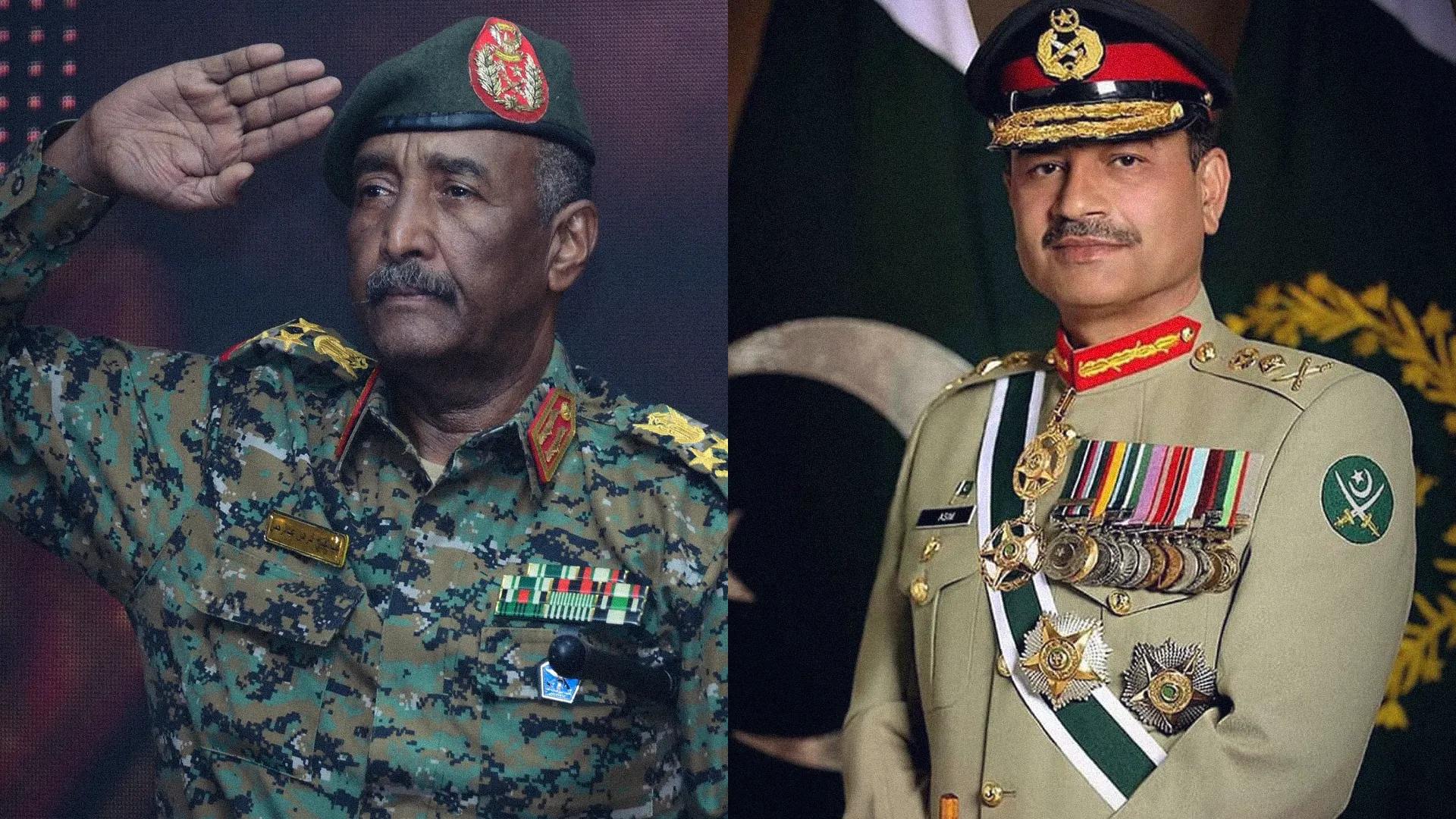
Al-Sultan argued that without support from the two countries, the Sudanese Army — led by Gen. Abdel Fattah al-Burhan — would have been defeated by the RSF, the paramilitary force commanded by Mohamed Hamdan Dagalo, widely known as Hemedti. He warned that, absent that support, the RSF could otherwise have reached Sudan's Red Sea coast and threatened the Egyptian-Sudanese border.
Crucially, Al-Sultan framed Saudi Arabia's position as support for the Sudanese state and its army rather than for Burhan personally. "Saudi Arabia is the one that stood with the Sudanese Army," he said, adding that the Saudi government had supported "the Sudanese state, above Burhan and above individual names."
He then pointed to Pakistan's military assistance, claiming that Saudi Arabia arranged arms deals for the Sudanese Army during the conflict. The support, he said, included armoured vehicles, tanks, aircraft and drones, and came at a difficult point for the army. "Without Saudi Arabia and Pakistan, the Sudanese Army would have been defeated," he said.
His comments portray Saudi Arabia as far more than a diplomatic actor in Sudan — crediting Saudi support with helping preserve the Sudanese Army's position against the RSF. He attributed the army's battlefield gains to the courage of the Sudanese people and Saudi support, after first acknowledging what he described as the role of God Almighty.
Al-Sultan also criticised Egypt's handling of the conflict, describing the Egyptian government's position as "very weak" and arguing that Saudi and Pakistani support had helped prevent the RSF from reaching the Red Sea.
What the reporting says about the deal
Al-Sultan's claims align with a body of reporting that has accumulated over the past year. In January 2026, Reuters reported that Pakistan was in the final phases of striking a $1.5 billion deal to supply weapons and jets to Sudan, with a former senior air force official suggesting the finances could come from Saudi Arabia. Al Jazeera subsequently examined whether the deal signalled a broader Pakistani military footprint across the Arab world, while the Washington Institute noted that Pakistan's entry into a Saudi–Egyptian–Turkish alignment supporting the Sudanese Armed Forces (SAF) was "particularly noteworthy" because it reportedly involved Riyadh as an intermediary.
The picture grew more complicated in April 2026, when Al-Monitor reported that Pakistan had placed the $1.5 billion sale on hold after Saudi Arabia asked for the agreement to be terminated and said it would not finance the purchase — even though the deal had originally been brokered by Riyadh. A separate Al-Monitor report framed the moment around a Jeddah meeting between Saudi Crown Prince Mohammed bin Salman and Burhan.
Despite that reported pause, the flow of equipment appears to have continued. The Defense Post reported in August 2026 that Sudan had taken delivery of roughly 100 Pakistani-made Mohafiz infantry mobility vehicles, with planned deployment across Kordofan and Darfur. The reported sighting of Pakistani Mohafiz-V armoured vehicles during a military parade in Khartoum was described as the first visual evidence of Pakistani military equipment reaching the Sudanese army.
Reporting has suggested the package extends well beyond armoured vehicles. According to News18, the reported Pakistani package could include Shahpar-2 armed drones, YIHA-III loitering munitions, K-8 Karakorum training and light attack aircraft, and air-defence systems. Conflict-monitoring group ACLED has separately documented the SAF's diversified drone arsenal — including Turkish-Pakistani YIHA-III systems — and noted that even after the reported Saudi halt in April, the rate of SAF air- and drone strikes remained steady. A policy analysis by BARQ went further, citing an Intelligence Online report that Saudi Arabia had supplied heavy artillery, including U.S.-made M777 howitzers, to the SAF.
A track record that worries the Baloch

Interested in this ad?
Would you like to continue to the link or provide your information for more details?
Please provide your information
To continue, please fill in your details
The same Pakistani military being credited with sustaining Sudan's army carries a long-documented record of using heavy force against its own population — particularly in Balochistan. Pakistani security forces have repeatedly deployed gunship helicopters, drones and fixed-wing aircraft against Baloch armed groups and, according to local sources and rights organisations, against civilian areas.
Al Jazeera reported in February 2026 that Pakistan deployed helicopters and drones to retake the town of Nushki from Baloch rebels after a three-day battle. The Balochistan Times has documented "gunship helicopters and drones" carrying out shelling and bombardment during operations in Khuzdar and Kalat, and reported large-scale operations in Bolan involving military helicopters conducting heavy shelling. Balochwarna News has described "large-scale ground and aerial offensives" across Nushki, Surab, Jhao and Mastung. In August 2026, CNBC TV18 reported fresh Pakistani airstrikes in Balochistan after BLA attacks, reports alleging that Pakistani Air Force bombardment in the Gidar area of Surab killed more than 30 civilians, including women and children — an account echoed by IANS, which reported Baloch activists rejecting the military's official version of the incident.
This is the backdrop against which Baloch organisations view the Sudan arms deal with alarm.
Baloch groups appeal to the UN
The Baloch Peoples Congress (BPC), together with allied Baloch, Pashtoon and Sindhi organisations and activists, has accused Pakistan's military of supplying weapons and military equipment to Sudan — and has formally appealed to the United Nations and other international bodies to intervene.
In a press statement, the BPC expressed concern over reports that the Pakistani-made Mohafiz-V armoured vehicle appeared in a Sudanese military parade — the first public evidence, it said, of the vehicle's presence in the conflict-hit country. The vehicle is manufactured by HIT Armour, a subsidiary of Pakistan's state-owned Heavy Industries Taxila (HIT). The BPC alleged the transfer may be part of a wider package including YIHA-III suicide drones, Shahpar-2 drones, K-8 Karakorum aircraft and Chinese-origin air-defence systems.
The appeal is framed in explicitly legal terms. The BPC argues that the reported arms transfers violate the UN Charter and international law governing arms sales, and it has called for:
-
An immediate suspension of all alleged Pakistani arms transfers to Sudan;
-
An independent investigation into the reported military cooperation, including its financing and intermediaries;
-
Accountability for the alleged use of such weapons against civilians;
-
An audit of revenue generated from arms exports; and
-
Intervention by the United Nations, the African Union and international human rights bodies to prevent further militarisation of the Sudan conflict.
News18 reported that the BPC and allied organisations fear the revenue from the deal — estimated at around $1.5 billion — could be reinvested into Pakistan's military, further strengthening its domestic security operations in Baloch, Sindhi and Pashtun regions. EU Today echoed that concern, noting the BPC's warning that part of the deal's proceeds could enhance the military's capacity to fund internal operations.
The BPC linked the Sudan transfers directly to Pakistan's domestic conduct, arguing that pumping more weapons into Sudan could worsen its humanitarian crisis and mirror what it described as the Pakistani state's use of military force in Baloch, Sindhi and Pashtun regions.
Why it matters
Neither the governments of Pakistan nor Sudan have officially confirmed the deal, and Riyadh has never publicly acknowledged a combat role in Sudan. That is precisely what makes Al-Sultan's commentary striking: it is a rare, on-the-record articulation of a Saudi-aligned view that Saudi Arabia and Pakistan have been decisive military backers of the Sudanese Army — not merely mediators.
The episode also binds together two conflicts that are rarely discussed in the same breath. In Sudan, the reported Pakistani-Saudi pipeline has helped the SAF regain ground and air capability against the RSF. In Balochistan, the same military exporting that hardware maintains a campaign of helicopter gunship strikes, drone attacks and aerial bombardment against Baloch communities.
For the Baloch organisations appealing to the UN, the connection is direct: weapons flowing out of Pakistan to Sudan, they argue, are financed and facilitated by a state that uses the same class of weapons against its own people — and the revenue, they warn, could fund more of the same. Whether the UN, the African Union or any other body will act on that appeal remains an open question. What is no longer in question is that the Sudan war has become a theatre in which Pakistan's defence industry, Saudi financing, and Pakistan's domestic conflicts in Balochistan are now uncomfortably intertwined.