

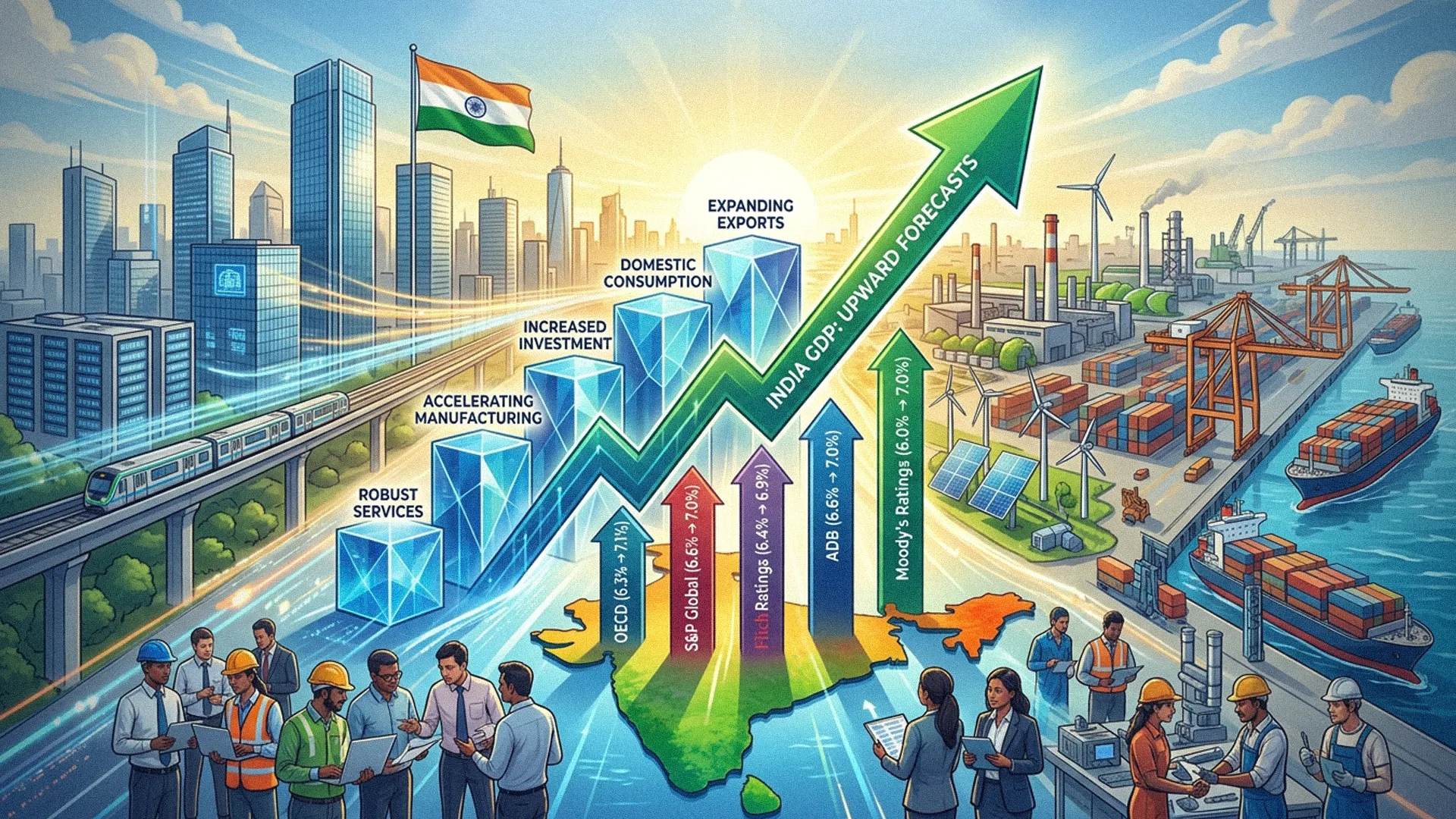
Recently, several major international institutions have raised their growth forecasts for the Indian economy. The latest revisions from the OECD, S&P Global, Fitch Ratings, the Asian Development Bank (ADB), and Moody’s Ratings signal growing recognition of India’s growth momentum and its ability to withstand a challenging global economic environment. The OECD has raised its forecast for India’s GDP growth from 6.3% to 7.1%, while S&P Global has revised its projection from 6.6% to 7%. Fitch Ratings has increased its forecast from 6.4% to 6.9%, ADB from 6.6% to 7%, and Moody’s Ratings from 6% to 7%. Thus, all five have raised their projections, with four now placing India’s growth at around 7% or higher.
The Growth Story So Far
| S.No | Organization | Before | After |
| 1 | OECD | 6.3% | 7.1% |
| 2 | S&P Global | 6.6% | 7% |
| 3 | Fitch Rating | 6.4% | 6.9% |
| 4 | ADB | 6.6% | 7% |
| 5 | Moody’s Rating | 6% | 7% |
These revisions matter because they are not happening in isolation. They coincide with evidence of strengthening domestic economic activity across several key components of GDP. India’s growth story is increasingly supported by multiple engines rather than by a single sector or source of demand. India’s real GDP growth reflects a strong post-pandemic recovery and sustained momentum. After contracting sharply by 5.7% in FY2020-21, the economy rebounded with 9.6% growth in FY2021-22. Growth remained robust at 7.6% in FY2022-23, 7.3% in FY2023-24, and 7.2% in FY2024-25, and accelerated to 7.8% in FY2025-26, highlighting India’s resilience and continued strength despite global economic uncertainties.
Growth momentum provides the foundation
The latest quarterly performance helps explain the more positive external assessment of India. Real GDP growth accelerated to 7.8% in Q1 FY2026-27, compared with 6.9% in Q1 FY2025-26. Nominal GDP growth also strengthened to 10.3%, compared with 8.1% a year earlier, taking GDP to ₹88.27 lakh crore. Real GVA growth increased to 8.2% from 7%, while nominal GVA expanded by 11.5%. These figures indicate that the improvement is not confined to headline GDP but is also evident in underlying economic activity.
Services remain a powerful growth engine
One of the most important pillars of India's resilience is the continued strength of the services sector. Tertiary-sector growth accelerated to 10%, up from 8% the previous year. Within services, financial, real estate, IT and professional services grew by 12.1%, making them the strongest major segment identified in the report. Trade, hotels, transport, communication and related services expanded by 8.5%, while public administration, defence and other services grew by 7.5%.
The strength of these sectors is particularly relevant to India's position in the global economy. IT and professional services connect India to international markets, while financial and business services increasingly support domestic investment and enterprise activity. The continued expansion of these segments therefore provides both domestic momentum and an important external link.
Manufacturing and industrial activity add another layer of resilience
India's resilience is increasingly supported by the industrial sector. The secondary sector grew by 8.6%, substantially faster than the 6.1% recorded a year earlier. Manufacturing growth accelerated to 9.2% from 8.3%, while construction expanded by 7.7%, compared with 5.2% previously. Electricity, gas, water supply and other utility services grew 8.9%, reversing a 1.8% contraction a year earlier. This broad-based improvement is important for the sustainability of India's growth trajectory. A combination of manufacturing, construction and infrastructure-related activity can strengthen productive capacity, employment opportunities and domestic supply chains. It also suggests that India's economic expansion is becoming more diversified. Strong services growth is complemented by industrial activity, thereby reducing dependence on any single sector.

Interested in this ad?
Would you like to continue to the link or provide your information for more details?
Please provide your information
To continue, please fill in your details
Investment is emerging as a major source of strength
Perhaps one of the most significant indicators of future economic resilience is the acceleration in investment. Gross fixed capital formation at current prices rose by 20.4% in Q1 FY2026-27, up from 5.4% in Q1 FY2025-26. This sharp increase signals stronger investment activity and capacity creation. Investment matters because it determines the economy's capacity to grow in subsequent years. Higher capital formation can expand productive capacity, improve infrastructure and support technological and industrial development. If sustained, stronger investment can therefore reinforce the foundations of the improved growth projections made by international institutions. The combination of high current growth and stronger capital formation is particularly relevant to India's global resilience. It suggests that part of the current expansion is linked to capacity creation rather than to short-term demand.
Domestic consumption provides stability
Another distinguishing feature of India's growth model is the importance of domestic demand. Private final consumption expenditure grew by 9.9% in Q1 FY2026-27, up from 8.3% in the corresponding period the previous year. More importantly, PFCE accounted for 55.6% of GDP, underscoring the continuing importance of household consumption to economic activity. The report notes that sustained consumption growth reflects resilient domestic demand. A large domestic consumption base provides an important stabilising factor when external economic conditions become uncertain.
Exports add to India's external strength
Strong export performance, alongside continued expansion in services and manufacturing, indicates that India's growth is increasingly linked to both international demand and domestic consumption. Total merchandise and services exports for April-August 2026 grew about 15% to USD 399 billion, up from USD 345 billion in the corresponding period last year. This combination is important for India's global economic positioning. A large domestic market provides a base for domestic growth, while expanding exports provide access to international markets. Together, they create a more diversified growth structure.
India’s Bright Position in the Global Growth Landscape
Upward revisions to India’s GDP growth forecasts by major international institutions reflect growing recognition of the economy’s strengthening fundamentals and broad-based growth momentum. India’s resilience is increasingly underpinned by multiple engines of growth, including robust services, accelerating manufacturing, rising investment, resilient domestic consumption and expanding exports.
This diversification is significant because it reduces dependence on any single sector and provides greater stability amid global economic uncertainty. Strong investment and capital formation are also enhancing productive capacity, while the expansion of manufacturing and services is strengthening India’s integration with global value chains and international markets. At the same time, a large domestic consumer base provides an important cushion against external shocks.
In a nutshell, these trends suggest that India’s growth is becoming more diversified, investment-driven and globally integrated. Sustaining this momentum through productivity gains, infrastructure development, technological advancement and employment generation could further strengthen India’s economic capacity and competitiveness, reinforcing its growing contribution to global economic growth at a much higher level.