Is the ‘Oli Kuti’ a Wasp Nest Look-Alike? Public Appeals: “Please Don’t Burn It”
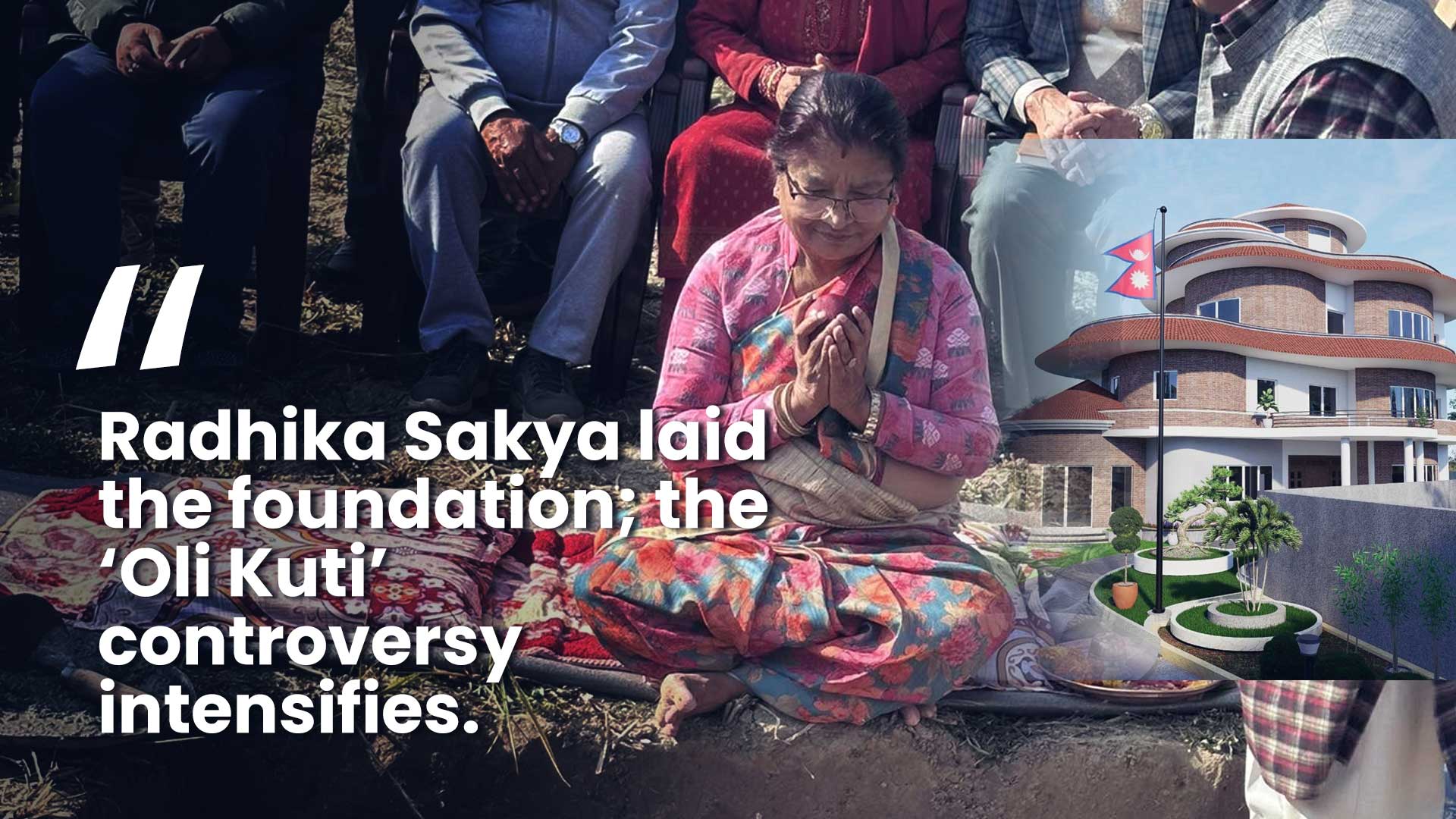
Kathmandu — Public debate intensified in Nepal after Mahesh Basnet, a senior leader of the Communist Party of Nepal (Unified Marxist–Leninist), announced on 4 December 2025 that construction of the “Oli Kuti” had officially begun, with former Prime Minister KP Sharma Oli’s wife, Radhika Sakya, laying the foundation stone. Although Basnet claimed the project would now “move ahead rapidly,” reactions quickly diverged over the intent and symbolism behind the structure.
According to Basnet, Sakya performed the groundbreaking ceremony at Gundu in Bhaktapur. Within hours, social media users began commenting on the design, with some calling it a simple “kuti” (hermitage), while others mocked it for resembling a wasp nest, locally called a “koti.” Several posts went further, joking, “Let’s hope no one mistakes it for a wasp nest and sets it on fire,” underscoring the symbolic tension surrounding the project.
Local media had previously reported that one of Oli’s residences was set on fire during the unrest linked to the Gen-Z movement. That incident resurfaced in public memory as critics described the new kuti as a “pre-election spectacle” or as an attempt to generate political sympathy. While Basnet has not stated any explicit political motive, such questions have grown central to the debate. Some social media commentators went as far as labeling the kuti “the residence of a deceitful and hypocritical person,” though such harsh assessments remain subjective and unverified.
Supporters, on the other hand, framed the construction as a routine development initiative and a gesture of respect toward Oli, interpreting it as part of cultural or spiritual activities. Yet the timing—coming amid ongoing political tensions after the Gen-Z uprising and in the run-up to national elections—has led observers to view the kuti as carrying more political weight than an ordinary private structure.
As construction progresses, the broader political and symbolic significance of the “Oli Kuti” will become clearer in the reactions it generates and the role it plays in Nepal’s evolving political landscape.

![From Kathmandu to the World: How Excel Students Are Winning Big [Admission Open]](https://www.nepalaaja.com/img/70194/medium/excel-college-info-eng-nep-2342.jpg)