

As China entered the nine-day Lunar New Year holiday in mid-February 2026, a period traditionally marked by family reunions and pointed questions about marriage and children, the state moved decisively to police the conversation.
On February 12, the country’s top internet regulator, the Cyberspace Administration of China, announced a month-long censorship drive aimed at creating what it described as a “festive, peaceful, and positive online atmosphere”.
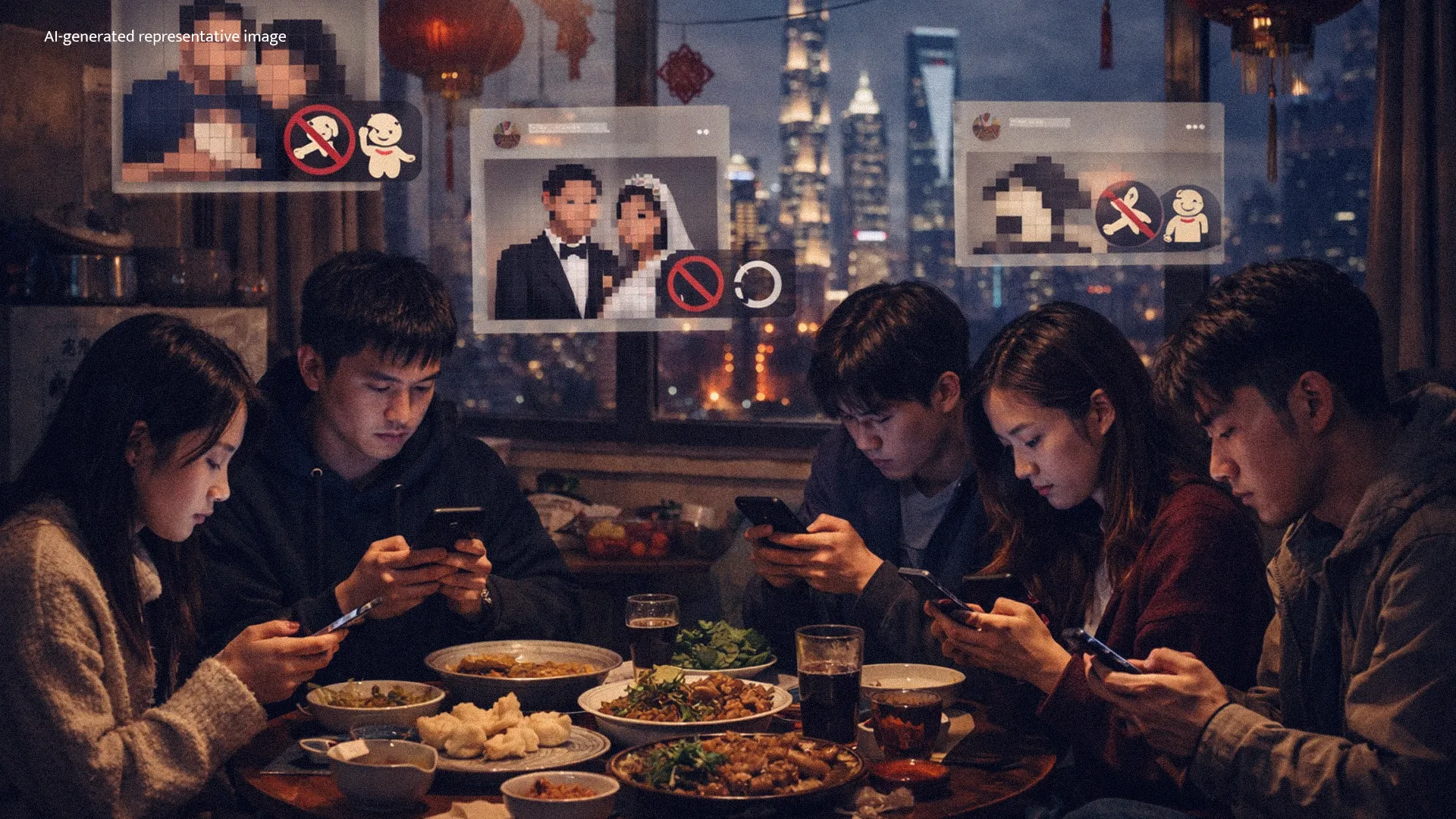
Central to this campaign was a renewed focus on suppressing online speech that questions marriage or discourages having children.
The timing was deliberate. The Lunar New Year remains one of the most socially charged moments in the Chinese calendar, when intergenerational expectations around family formation surface most visibly.
It is also a period of intense online activity, with creators, influencers, and ordinary users discussing relationships, careers, and the pressures of adulthood. For the second consecutive year, these discussions have come under explicit scrutiny from state censors.
Defining ‘harmful’ speech in demographic era
According to the regulator’s directive, platforms are required to identify and remove content that “maliciously incites negative emotions”.
This includes posts that promote or advocate what authorities call “unhealthy values”, such as not getting married, not having children, opposing marriage and childbirth, inciting gender antagonism, or amplifying “fear of marriage” and “anxiety about childbirth”.
The scope is deliberately broad, allowing a wide range of personal reflections, social commentary, or satire to be categorised as destabilising.
The campaign also targets other categories of content, including artificial intelligence-generated material labelled as “digital garbage”, online arguments between regions or fandoms, conspiracy theories, and information linked to gambling, sexual services, or divination.
Yet the repeated and explicit emphasis on family-related speech signals how deeply demographic concerns have entered China’s content-control apparatus.
This is not an isolated initiative. The same category of speech was singled out during the Lunar New Year censorship campaign in 2025.
Its reappearance in 2026 underscores the persistence of the problem it seeks to address — and the limited impact such measures have had on underlying demographic trends.
Population numbers that refuse to rebound
China’s population decline is no longer a projection but an established reality. Official figures released by the National Bureau of Statistics show that in 2025 the country recorded 7.92 million births, equivalent to 5.63 births per 1,000 people.
This was the lowest birth rate since 1949, the year the Chinese Communist Party took control of the mainland.
The contrast with recent history is stark. In 2016, the first full year after the abandonment of the one-child policy, China recorded around 18 million births. Within less than a decade, that figure has fallen by more than half. The same data set indicates that China’s total population has shrunk for four consecutive years, declining to approximately 1.4049 billion in 2025.
These figures frame the urgency behind Beijing’s actions. Demographic decline has implications for labour supply, economic growth, pension systems, and social stability — issues that feature prominently in official planning documents.
What is notable, however, is the degree to which narrative management has become a parallel tool alongside policy adjustments.
From population control to narrative control
For decades, the Chinese state exerted control over reproductive behaviour through direct restrictions.
The one-child policy, introduced around 1980 and formally scrapped in 2015, was credited by the authorities with preventing an estimated 400 million births.

Interested in this ad?
Would you like to continue to the link or provide your information for more details?
Please provide your information
To continue, please fill in your details
Its social and psychological legacy, however, remains deeply embedded, shaping attitudes towards family size, cost, and personal autonomy.
Since abandoning that policy, the state has shifted from limiting births to encouraging them.
Measures introduced over recent years include free preschool education programmes launched nationally in 2025, subsidies of roughly US$500 per year for each child under the age of three, and tax adjustments aimed at reshaping behaviour.
In December 2025, the government removed tax exemptions on condoms and oral contraceptives, granted exemptions to matchmaking agencies, and rolled out new tax breaks for childcare services and marriage-related businesses.
Despite this array of interventions, birth numbers have continued to fall. Against that backdrop, censorship of dissenting or sceptical voices has emerged as an additional lever.
The implication is clear: when material incentives and administrative reforms fail to shift behaviour, controlling the public narrative becomes an alternative means of intervention.
Online platforms as demographic battlegrounds
Chinese social media platforms have long functioned as semi-public spaces where personal anxieties intersect with broader social trends.
Discussions about the cost of living, housing affordability, job insecurity, and work-life balance frequently overlap with conversations about whether marriage and parenthood are viable choices.
During peak periods such as the Lunar New Year, these themes gain heightened visibility.
By instructing platforms to suppress content that frames remaining single or child-free as legitimate or desirable, the state effectively narrows the range of acceptable discourse.
The language used by regulators — focusing on emotional harm, unhealthy values, and social antagonism — places personal testimony and critical reflection in the same category as deliberate misinformation.
The inclusion of AI-generated content in the crackdown further illustrates the breadth of concern. Authorities have signalled unease not only with what is being said, but with the speed and scale at which such messages can circulate in an increasingly automated content ecosystem.
Data gaps and lingering questions
While official statistics provide a bleak picture, their credibility is not universally accepted. The reliability of Chinese demographic data has long been questioned, particularly in light of the state’s handling of information during the COVID-19 pandemic.
The exact number of deaths during that period remains unclear, as does the full demographic impact of prolonged lockdowns, healthcare strain, and economic disruption.
These uncertainties add another layer to the censorship debate. When public data is incomplete or contested, online discourse often becomes a channel for alternative interpretations and grassroots analysis. Restricting that discourse does not resolve the underlying ambiguity; it merely limits visibility.
Control without consensus
The renewed censorship campaign reflects a governing logic that prioritises stability and alignment over pluralism.
By framing reluctance towards marriage and childbearing as a problem of values and emotions, rather than one of structural conditions, the state positions itself as an arbiter not only of behaviour but of belief.
As China’s population continues to contract, the gap between official expectations and personal choices remains evident.
The tightening grip on online expression suggests an acknowledgement of that gap, even as the response focuses on managing its articulation rather than confronting its causes. In the demographic era, the politics of population has become inseparable from the politics of speech.