India–Nepal Economic Partnership Poised for Trade Boom by 2030
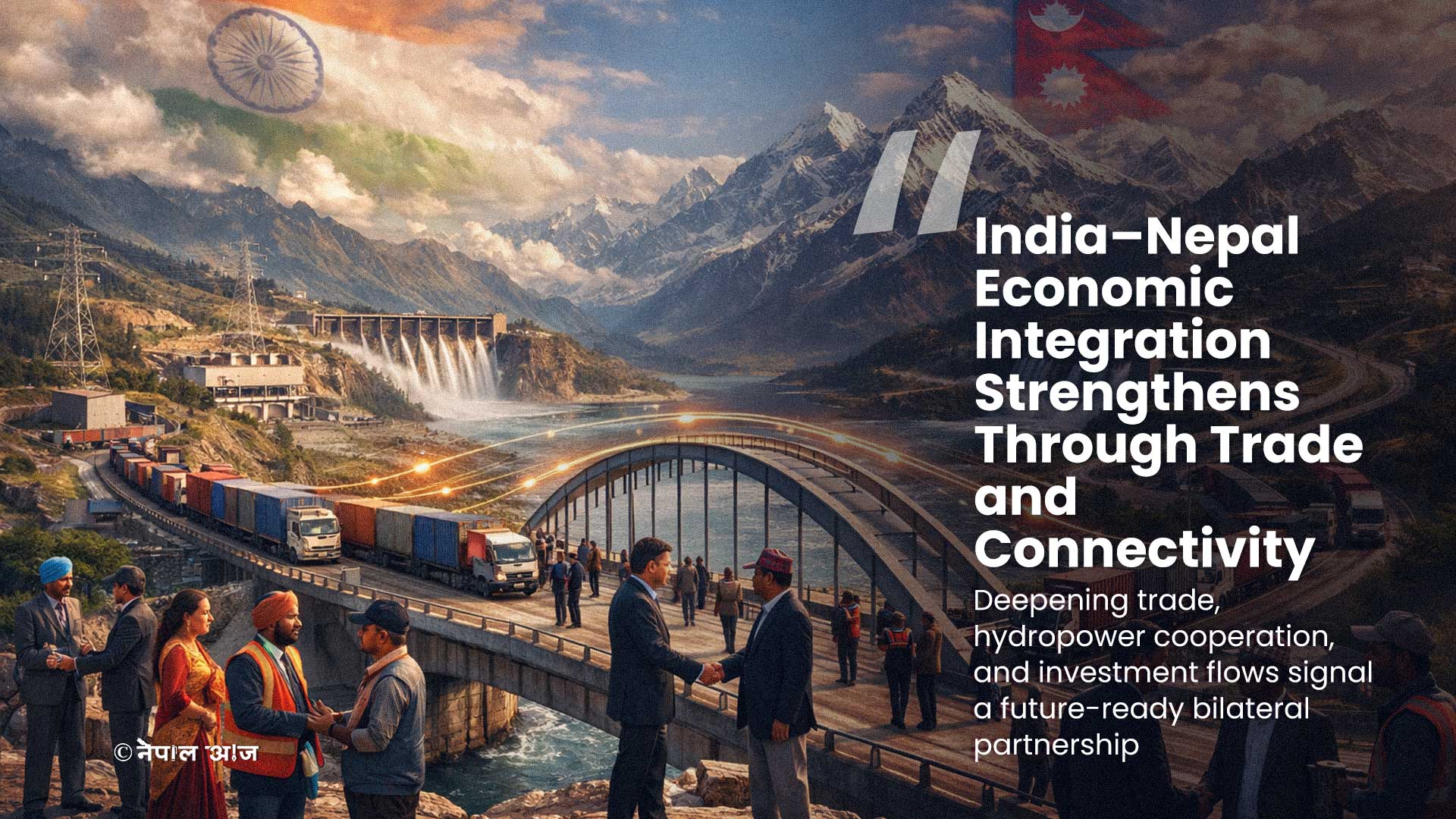
Strengthening business linkages and sustained investment flows are expected to drive bilateral trade into a new growth phase, with volumes likely to double by 2030.
India–Nepal relations reflect a deeply integrated economic partnership rooted in geography, history, and strong people-to-people ties. India is Nepal’s largest trade partner, investor, and development supporter, aiding infrastructure, energy, connectivity, and essential supplies. Expanding hydropower cooperation, cross-border connectivity, and labour mobility have strengthened long-term economic integration. The relations have evolved from transactional exchanges to a strategic, trust-based partnership focused on inclusive growth, regional stability, and shared prosperity for both nations.
India and Nepal share one of the most distinctive bilateral relationships in South Asia, shaped by geography, history, culture and enduring people-to-people ties. The 1950 Treaty of Peace and Friendship institutionalised these ties, granting reciprocal economic and residential privileges to citizens of both countries. Over the decades, this framework has enabled millions of Nepali citizens to live and work in India and facilitated seamless social and economic interactions. Unlike many international relations driven purely by strategic calculations, India–Nepal relations have evolved organically, rooted in daily economic exchange and social interdependence. This continuity has provided a strong foundation for cooperation in trade, investment, infrastructure and development, making shared prosperity a natural outcome rather than an abstract aspiration.
India- Nepal Economic Interdependence as a Strategic Necessity
Economic interdependence lies at the core of India–Nepal relations and reflects both structural realities and deliberate policy choices. India has consistently been Nepal’s most significant economic partner, accounting for the bulk of its trade, investment and development assistance. For Nepal, a landlocked economy with limited industrial capacity, access to the vast Indian market and Indian supply chains is critical for economic stability.
India supplies essential commodities such as petroleum products, medicines, fertilisers, machinery and food grains, ensuring price stability and continuity of supplies. At the same time, India has extended concessional lines of credit. It grantsbillions of dollars in support of Nepal’s infrastructure development, including highways, cross-border railways, transmission lines, and healthcare facilities. Strong labour linkages reinforce these economic ties; remittances from Nepali workers in India are estimated at around USD 1.2 billion annually, providing vital income support to households and contributing significantly to Nepal’s domestic demand and financial stability.
Trade as India-Nepal Relations Lifeline
Bilateral trade remains the most visible and measurable pillar of India–Nepal economic relations, reflecting both geographic proximity and deep-rooted interdependence. India accounts for over 64 per cent of Nepal’s total trade, underscoring its centrality to Nepal’s external economic engagement and supply chains. In FY 2024–25, total bilateral trade reached approximately USD 8.7 billion, reaffirming India’s position as Nepal’s largest trading partner by a wide margin. India’s exports to Nepal stood at about USD 7.4 billion, dominated by petroleum products, machinery, vehicles, pharmaceuticals, food items, and construction materials, which are critical to Nepal’s consumption and infrastructure needs.
Nepal’s exports to India, valued at nearly USD 1.3 billion, mainly include electricity, agricultural products, iron and steel items, and manufactured goods. This robust trade structure underscores both the extent of economic integration and the significant potential for diversification, value addition, and more balanced growth of Nepal’s export basket in the coming years. With growing business and investments, the trade trajectory is expected to enter a new phase, with bilateral trade doubling over the next five years.
Trade with Nepal (US$ Billion)
|
Year |
Exports |
Imports |
Total Trade |
|
2017-18 |
6.6 |
0.4 |
7.1 |
|
2018-19 |
7.8 |
0.5 |
8.3 |
|
2019-20 |
7.2 |
0.7 |
7.9 |
|
2020-21 |
6.8 |
0.7 |
7.5 |
|
2021-22 |
9.6 |
1.4 |
11.0 |
|
2022-23 |
8.1 |
0.8 |
8.9 |
|
2023-24 |
7.0 |
0.8 |
7.9 |
|
2024-25 |
7.4 |
1.3 |
8.7 |
Source: Ministry of Commerce, Government of India
The Logic of Economic Give and Take
Nepal’s imports from India play a stabilising role by ensuring the affordability and availability of essential goods, particularly during periods of global supply disruption. Indian supplies help moderate inflationary pressures in Nepal and support domestic manufacturing by providing reliable intermediate inputs. Conversely, Nepal’s exports to India, while modest in absolute value, are crucial for employment generation and foreign exchange earnings. India absorbs nearly 68 per cent of Nepal’s total exports, making it the most critical market for Nepali producers. Gradual improvements in customs infrastructure, integrated check posts and standards harmonisation are helping Nepali firms enhance competitiveness in Indian markets. This evolving give-and-take reflects a pragmatic partnership in which trade serves as a developmental tool, supporting livelihoods and economic resilience rather than functioning as a zero-sum exchange.
Investment Flows Cementing Long-Term Economic Integration
India–Nepal bilateral investments reflect a deepening economic partnership anchored in geographical proximity, historical trust, and growing strategic convergence. Indian companies constitute the largest source of foreign direct investment in Nepal, accounting for roughly 30–35 per cent of Nepal’s total FDI stock. Cumulative Indian investment is estimated at about USD 750–800 million, with operational investments of nearly USD 670 million spread across more than 150 Indian ventures. These investments span key sectors such as hydropower, manufacturing, banking, insurance, telecommunications, cement, tourism, education, and hospitality, making India a critical driver of Nepal’s industrialisation and services-sector expansion.
Indian public and private enterprises have played a particularly transformative role in Nepal’s hydropower sector by combining capital, technology, and assured power off-take arrangements, thereby strengthening Nepal’s energy security while creating long-term commercial returns for Indian firms. Indian banks and insurance companies have contributed to financial deepening and stability, while joint ventures in manufacturing and tourism have generated employment, skills, and local value addition.
This investment synergy is reinforced by India’s broader development partnership initiatives, which support infrastructure creation, cross-border connectivity, and capacity building, thereby lowering investment risks and enhancing economic integration. Together, investment flows and development finance are knitting the two economies into a closely interconnected economic space with shared long-term interests.
Energy Cooperation: Transforming the Economic Landscape
Energy cooperation has emerged as a transformative pillar of India–Nepal relations, redefining Nepal’s role in the regional economy. Nepal possesses vast hydropower potential, estimated at over 40,000 MW of economically viable capacity. In recent years, concerted efforts by both governments have enabled Nepal to transition from a net importer of electricity to a growing exporter. In fiscal year 2024–25, Nepal exported approximately NPR 17–18 billion (about USD 130 million) in electricity, with the majority sold to India. Long-term power trade agreements envisage Nepal exporting up to 10,000 MW of electricity to India over the coming decade. This energy partnership provides Nepal with a stable source of export revenue while supporting India’s clean energy transition and regional grid stability. The integration of power markets has also positioned India as a transit country for Nepal’s electricity exports to third countries, further enhancing regional economic cooperation.
Infrastructure Connectivity as an Engine of Shared Growth
Infrastructure development has been central to translating economic cooperation into tangible outcomes. India has supported the construction of highways, cross-border rail links, integrated check posts and transmission lines that significantly reduce transaction costs and improve ease of doing business. Cross-border rail connectivity has enhanced freight movement, while integrated check posts have streamlined customs procedures and reduced delays. Indian-funded road projects have improved connectivity within Nepal, linking production centres to markets more efficiently. Transmission infrastructure has enabled large-scale power trade, transforming energy cooperation from aspiration into reality. These infrastructure investments have a multiplier effect, stimulating private investment, boosting tourism and enhancing Nepal’s integration with regional value chains. By addressing structural bottlenecks, connectivity initiatives are converting Nepal’s geographic proximity to India into a durable economic advantage.
Human Capital, Remittances and Social Interdependence
Human mobility is a defining feature of India–Nepal relations and a critical channel of shared prosperity. Millions of Nepali citizens work in India across construction, manufacturing, services and security sectors, benefiting from open-border arrangements. Remittances from India, estimated at around USD 1.2 billion annually, provide a crucial source of income for Nepali households and support domestic consumption. Beyond remittances, access to Indian education, healthcare and training institutions enhances human capital formation in Nepal. Thousands of Nepali students study in Indian universities each year, while Indian medical facilities serve as an essential healthcare destination for Nepali citizens. These social and economic linkages reinforce the depth of interdependence, making India–Nepal relations not merely state-to-state but people-driven and resilient.
Charting a Future-Oriented Economic Partnership
Looking ahead, the future of India–Nepal economic relations lies in deeper integration across clean energy, digital services, climate resilience and tourism. Expansion of cross-border electricity trade and green energy corridors can position Nepal as a regional renewable energy hub. Digital payments and fintech cooperation can lower remittance costs, enhance financial inclusion and formalise cross-border transactions. Joint ventures in agri-processing, pharmaceuticals and eco-tourism can help Nepal move up the value chain while offering Indian firms new growth opportunities. As climate risks intensify, cooperation in water management, disaster preparedness and sustainable infrastructure will become increasingly critical. A forward-looking partnership anchored in innovation and sustainability can ensure that economic cooperation remains relevant in a rapidly evolving global environment.
Shared Prosperity as the Lasting Promise
India–Nepal relations demonstrate how neighbourhood partnerships, when rooted in trust, proximity and mutual respect, can generate shared prosperity. The scale of trade, depth of investment, expanding energy cooperation and dense human linkages build an economic relationship that is both strategic and humane. For Nepal, India remains an indispensable partner in development, connectivity and market access. For India, Nepal is a trusted neighbour whose stability and growth contribute to regional security and integration. The opportunities ahead lie in making this partnership more balanced, diversified and future-ready, ensuring that growth translates into inclusive development. If nurtured with vision and sensitivity, the India–Nepal partnership will continue to stand as a model of cooperative development in South Asia, reaffirming the principle that prosperity is strongest when it is shared.
India-Nepal Building Partnerships



![From Kathmandu to the World: How Excel Students Are Winning Big [Admission Open]](https://www.nepalaaja.com/img/70194/medium/excel-college-info-eng-nep-2342.jpg)